
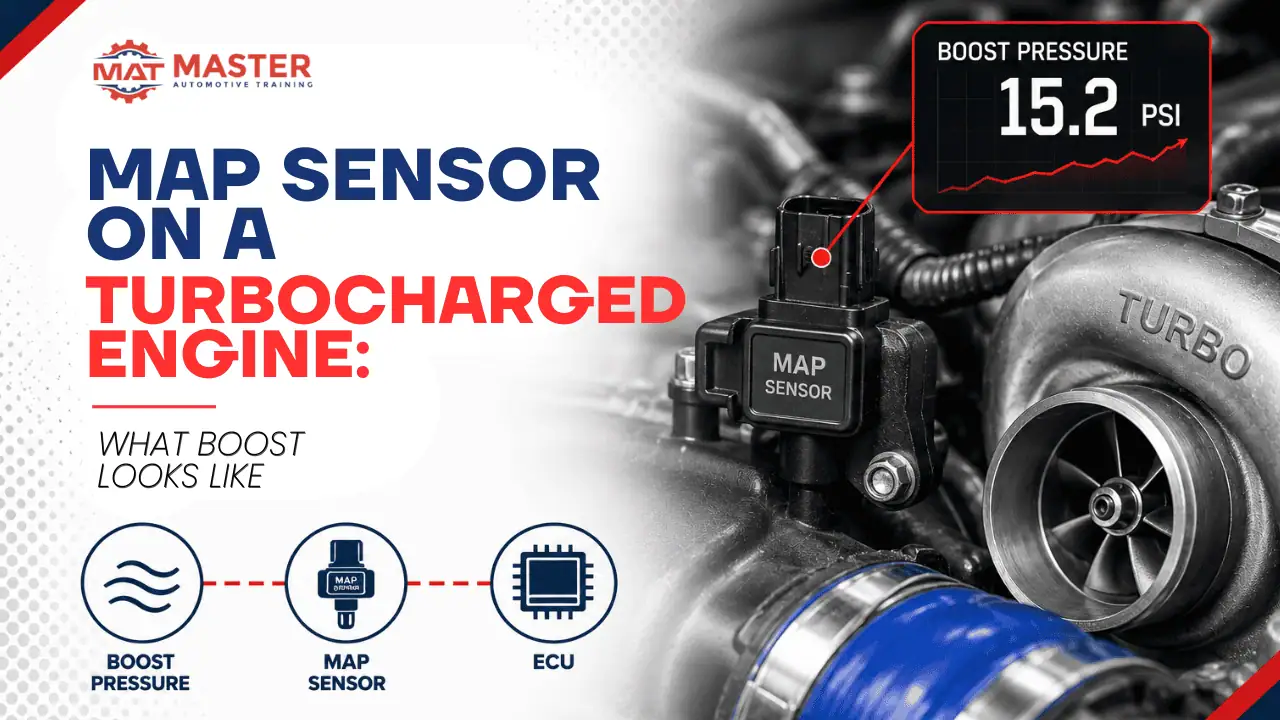
MAP Sensor on a Turbocharged Engine: What Boost Looks Like
A question came in after the last diagnostic post: “what about MAP sensor readings on a turbocharged engine?”
Good question. The short answer: a MAP sensor on a turbocharged engine follows the exact same rules as one on a naturally aspirated engine — right up until the moment the turbo starts to spool. Then one thing changes, and it changes everything.
Here’s how to read a MAP sensor on a turbo car without getting lost, and how to use it to catch problems that don’t look like MAP problems at all.
1. The Baseline: Key On, Engine Off
Start where every MAP diagnosis starts, turbo or not.
With the key on and the engine off, the MAP sensor is reading atmospheric pressure. On a standard-day sea-level reference, that’s roughly 101.3 kilopascal or 29.9 inches of mercury.
That number changes with your altitude and the weather that day. If you’re at elevation, or a storm system just moved through, the reading will be lower. That’s not a fault. That’s physics.
Whatever atmospheric pressure your MAP reads at KOEO — that’s your reference point for the rest of the test.
2. Warm Idle: Still No Different Than Naturally Aspirated
Start the engine and let it come up to operating temperature. Watch the MAP reading settle.
At warm idle on a turbocharged engine, intake vacuum pulls the MAP reading down to somewhere around 25 to 45 kilopascal — roughly 8 to 12 inches of mercury. That’s identical to what you’d see on a naturally aspirated engine.
Why? Because at idle, there’s no boost. The turbo isn’t spooled. The throttle plate is nearly closed and the engine is drawing air the same way any engine draws air — through vacuum.
Nothing separates a turbo from an NA engine yet. The difference doesn’t show up until the throttle opens and the turbo starts building.
3. The Threshold That Changes Everything
Here’s where the two engine types split, and it’s the single most important line in this diagnosis.
101.3 kPa is the threshold.
- Anything below 101.3 kPa is vacuum. No boost. Air is being drawn in.
- Anything above 101.3 kPa is positive boost pressure. Air is being pushed in.
On a naturally aspirated engine, the MAP reading never crosses that line. It can approach atmospheric under wide-open throttle, but it can’t exceed it — there’s no mechanism to force air in.
On a turbocharged engine under boost, the MAP absolutely does cross that line. That’s the whole point of the turbo — to push air into the engine at pressures higher than the atmosphere provides.
Graph the MAP during a controlled acceleration pull and watch it happen live. The trace climbs out of vacuum, passes through atmospheric, and continues rising into positive territory as the turbo builds.
101.3 kPa is where a MAP sensor stops describing the atmosphere and starts describing the turbo.
4. Converting MAP to Actual Boost
Once the MAP reading climbs above atmospheric, you probably want to translate that into the boost pressure the gauge would show. The math is straightforward.
Take your MAP reading in kilopascals. Subtract 101.3. Then multiply the result by 0.145.
That’s your boost pressure in PSI.
Quick worked example. Say the MAP reads 220 kPa at peak boost:
- 220 − 101.3 = 118.7
- 118.7 × 0.145 ≈ 17.2 PSI of boost
Do that math once and you’ll never confuse absolute pressure and gauge pressure again. And you’ll never wonder whether a “high” MAP reading on a turbo car is a fault or a feature.
5. Sensor Range Matters — A Lot
There’s one specification that will burn a diagnosis faster than anything else on a turbo car: the MAP sensor’s pressure range.
A standard 1.5 bar MAP sensor maxes out at roughly 150 kPa. That’s fine for a naturally aspirated engine, and fine for a low-boost turbo application at part-throttle. But push into serious boost and that sensor pegs out — reports the maximum value it can, and no more.
When that happens, you get:
- Clipped data at the top of the trace
- Fuel and timing calculations based on incomplete information
- Codes that look random because the underlying data is chopped off
High-boost applications need a 2 bar sensor or higher — otherwise the sensor stops describing what the engine is actually doing.
Check the vehicle’s spec before you condemn a reading that looks weird at peak boost. The problem may not be the reading. It may be the ceiling.
6. The Diagnostic Move — When MAP Doesn’t Rise Under Boost
Here’s the payoff. Everything above is setup for this one move.
Take the car for a wide-open-throttle pull and graph the MAP alongside RPM and throttle position. If the MAP climbs cleanly past 101.3 kPa and rises with the turbo, everything is working the way it should.
But if the throttle is wide open, the RPM is climbing, and the MAP is not rising above atmospheric — you’ve just found something.
That’s not a MAP sensor problem. That’s a boost problem.
The MAP is doing its job. It’s reporting exactly what’s happening in the intake manifold — and what’s happening is that the turbo isn’t building the boost the engine expects. Now you know where to look:
- A wastegate stuck open, or a wastegate actuator that isn’t holding
- A boost leak in the intake plumbing between the turbo and the throttle body
- A turbo that isn’t spooling — worn bearings, damaged compressor wheel, oil starvation
- A boost control solenoid that isn’t commanding the right pressure
None of those show up as a “MAP sensor” fault. But the MAP is the sensor that reveals them, because it’s telling you exactly what pressure the engine is seeing.
The MAP just told you where to look. It’s up to you to understand what it’s saying.
The Bottom Line
A MAP sensor on a turbocharged engine reads vacuum at idle, atmospheric at KOEO, and positive pressure under boost. The math to convert kPa into PSI is one subtraction and one multiplication. And the moment the MAP stops climbing when it should be climbing — you’ve stopped diagnosing the sensor and started diagnosing the turbo.
Reading data is easy. Understanding what the data is telling you is where the diagnosis lives.
Master Automotive Training teaches this level of sensor-reading discipline across the full curriculum — automotive diagnostics, graph mode and scope work, EV/Hybrid (L3), and more. Real cars, real bays, real learning.
Bettering the automotive industry one technician at a time.