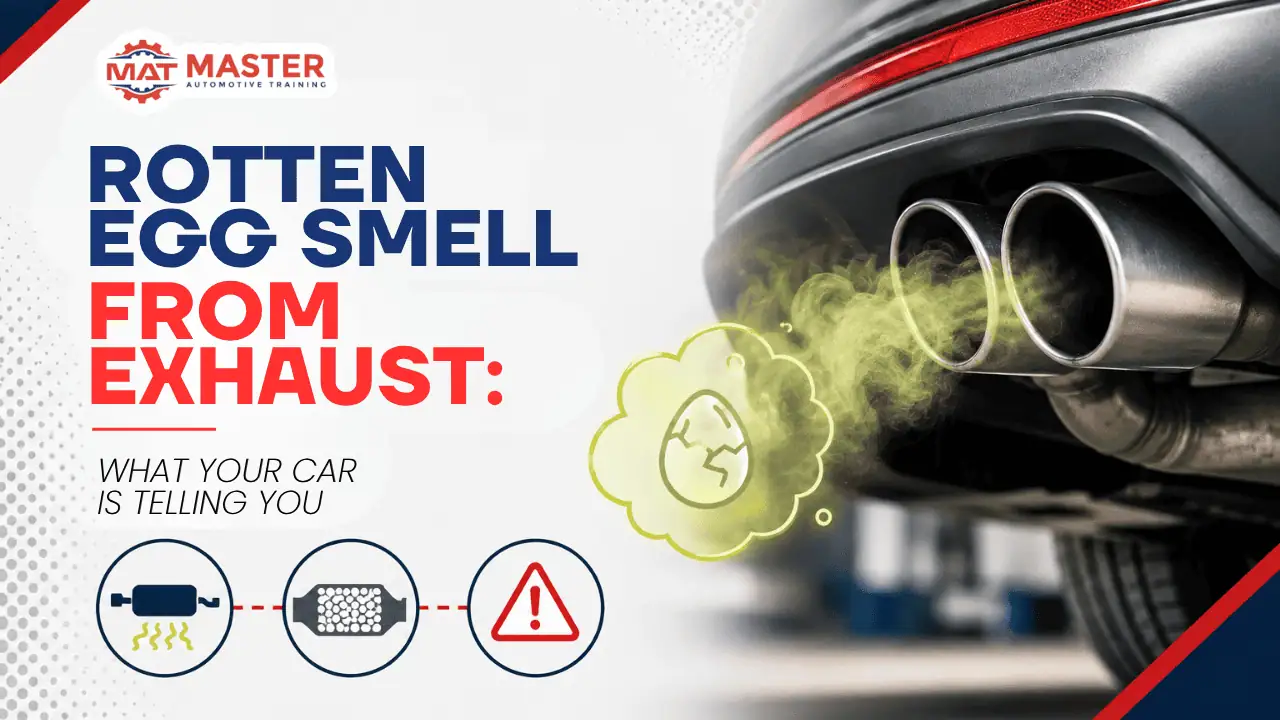
Rotten Egg Smell From Exhaust: What Your Car Is Telling You
We got a question after our exhaust color video: “what if my exhaust smells like pure sulfur?”
Great question — and if that’s what you’re smelling, your car is telling you something very specific. Something’s wrong with the catalytic converter, and the smell is the report.
Here’s what a rotten egg smell from exhaust actually means, what’s causing it, and what a good shop will do before they recommend a repair.
What That Smell Actually Is
Gasoline contains small amounts of sulfur compounds. Every time your engine burns fuel, those compounds pass into the exhaust stream on their way out of the car.
Your catalytic converter’s job is to grab those compounds and convert them into sulfur dioxide (SO2), which is essentially odorless. That’s why a healthy car with a working cat doesn’t announce itself in the parking lot.
When you smell a strong, unmistakable rotten egg odor coming from your tailpipe, one thing has happened: the catalytic converter is not completing that conversion. The sulfur is going in — and coming out the other side, unchanged.
The smell isn’t the problem. It’s the report.
The car is telling you the cat has stopped doing one of the specific jobs it’s designed to do. Now the question is why.
The Two Root Causes of a Sulfur Smell From Your Exhaust
There are two main reasons the cat stops converting sulfur properly. Any good shop should know both — and rule out both — before recommending a replacement.
Cause One — The Catalytic Converter Itself Is Failing
Catalytic converters aren’t permanent. The precious metals coating the internal substrate — platinum, palladium, rhodium — wear out over years and miles. Over time, the chemistry that makes the cat work gets slower and less complete.
That process accelerates if the engine has been running rich for a while. Excess unburned fuel pushed through the exhaust hits the hot cat, ignites inside it, and damages the internal structure from the inside out. A cat that’s been fed a rich mixture for months is a cat that’s aging fast.
Cause Two — The Engine Is Running Rich Right Now
This is the cause most drivers don’t hear about — and the one that matters most for what happens next.
An engine can run rich for a lot of reasons:
- A leaking or dripping fuel injector
- A failing fuel pressure regulator holding pressure too high
- A dirty or under-reporting mass airflow sensor
- A stuck-open coolant temperature sensor keeping the engine in warm-up mode
- A vacuum leak affecting fuel trim in the wrong direction
When any of these are happening, the engine is dumping more fuel into the cylinders than it should. The cat gets overwhelmed with more sulfur than it can convert. The smell shows up — even if the cat itself isn’t damaged yet.
A new cat installed on an engine still running rich will smell just as bad in a few thousand miles. That’s the trap. Replace the wrong part and the same complaint comes right back.
When the Smell Is Normal — And When It Isn’t
Not every whiff of sulfur means something is wrong. Context matters.
Occasional, brief sulfur smell after a hard acceleration or a long climb. This can be perfectly normal. A momentarily rich condition under heavy load produces more sulfur than the cat can handle for a second or two. The smell clears quickly and doesn’t return.
Persistent, strong sulfur smell at normal driving. Not normal. That’s your cat waving a flag. Something is out of spec — either in the cat itself or upstream in the fuel system — and it needs to be diagnosed before the smell gets worse and the repair gets bigger.
If you’re noticing the smell every day, on short trips, at highway speeds, in the drive-through — it’s not going to fix itself. That’s when it goes to the shop.
What a Good Shop Will Actually Do
Here’s the part that separates a shop that fixes cars from a shop that just replaces parts.
A good shop won’t quote you a new catalytic converter the moment they smell the sulfur. They’ll test the fuel system first:
- Scan for stored codes and freeze frame data
- Look at fuel trims at idle and cruise to see if the engine is running rich
- Check fuel pressure and hold pressure at rest
- Verify the mass airflow sensor is reading accurately under load
- Confirm the upstream oxygen or air-fuel ratio sensor is doing its job
If they find a rich condition and fix that first, the smell may go away without ever touching the cat. If the cat is genuinely damaged, they’ll have already ruled out the upstream causes so a replacement actually solves the problem — permanently.
Find out why before you replace it.
Why This Matters for Your Wallet
A catalytic converter replacement on a modern vehicle ranges from a few hundred dollars to well over two thousand, depending on the car. A fuel system fix — an injector, a pressure regulator, a sensor — is usually a fraction of that.
Now imagine the shop diagnoses backwards. New cat goes on. Bill gets paid. Rich condition is still there. Three months later, the smell is back. Now you’re paying for both.
Getting the order right the first time is the difference between one repair and two. A shop that takes the time to test is a shop that respects your time and your money.
The Bottom Line
A rotten egg smell from your exhaust isn’t just an annoyance. It’s your car telling you the catalytic converter has stopped doing part of its job — and the reason it stopped matters as much as the fact that it did.
The smell is the report. The diagnosis is the answer. Confirm the cause before you replace the part.
If you’re in Rancho Cucamonga and something in the exhaust doesn’t smell right, Master Auto Care runs the full diagnosis — cat, sensors, fuel trim, and everything upstream — before we recommend a repair. That way you only fix what actually needs fixing.
Honesty drives, and safety thrives.