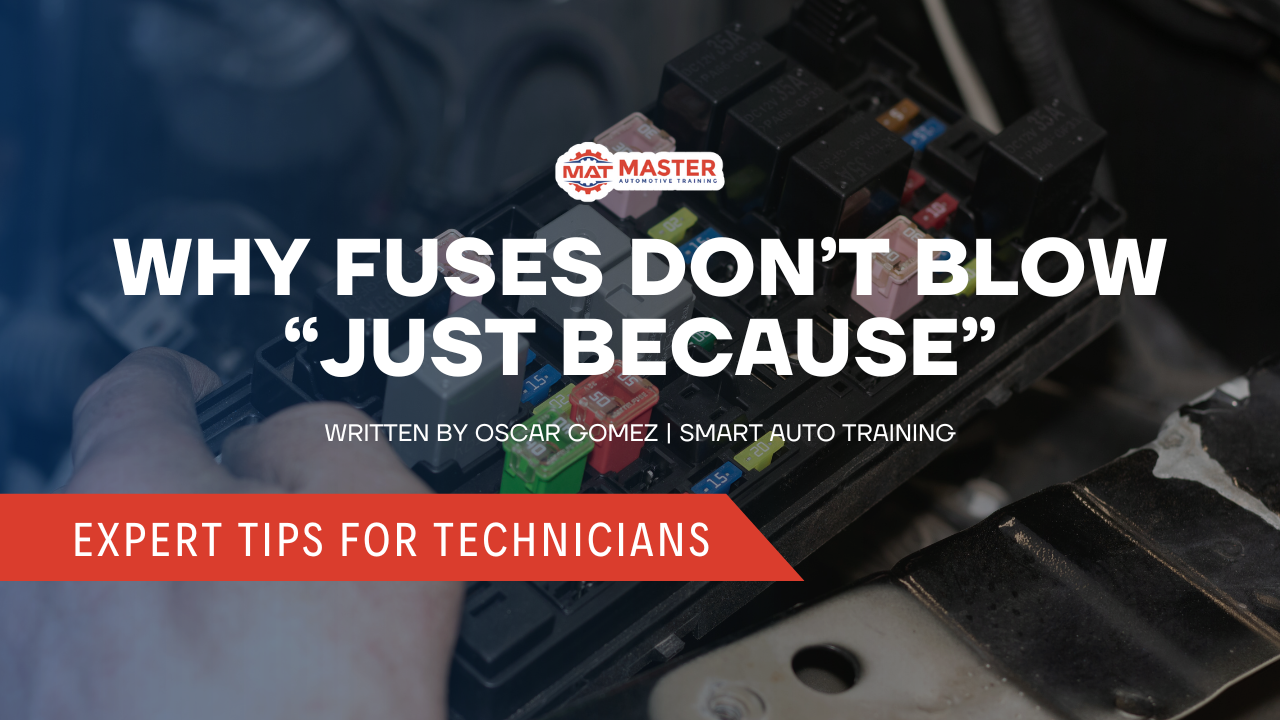
How many times have you heard this in the shop?
“Yeah, the fuse blew… must’ve been a fluke.”
Let’s get one thing straight:
Fuses don’t blow for no reason. They don’t get bored. They don’t just quit. When a fuse blows, it’s trying to tell you something important.
The Real Role of a Fuse
Think of a fuse as the bodyguard of your circuit. It’s the weak link on purpose—designed to break first before wires melt or modules fry.
So when it blows, it’s sounding the alarm:
“Something downstream pulled too much current.”
That means something exceeded the safe amperage limit of the fuse. And now it’s your job to find out what.
It’s Not Always a Direct Short
Sure, a blown fuse might point to a short to ground. But that’s not the only cause.
Sometimes the culprit is a component that’s slowly failing—drawing more current than normal. This could be:
- A worn-out motor
- A stuck compressor clutch
- A fuel pump working harder than it should
- A corroded connection increasing resistance
These issues build up over time until the fuse finally says, “I’m out.”
What Not to Do (Seriously)
Here’s what not to do when you find a blown fuse:
- Don’t throw in another fuse and call it a day
- Don’t use a paperclip or jumper wire to bypass it
- Don’t install a higher-rated fuse “just to get it home”
Why? Because these quick fixes can cause wires to overheat, modules to burn, or entire harnesses to melt. Worse yet, it can turn a $5 fuse into a $5,000 repair—or worse, a fire hazard.
Golden Nugget
Every blown fuse is a red flag. Ignore it, and the next thing that blows might be your reputation.
Train to Diagnose, Not Guess
At Smart Auto Training, we teach students to think like pros. That means learning:
- How to read fuse amperage ratings
- How to test for current draw
- How to find the real cause behind electrical overloads
We don’t train “parts changers.” We build diagnostic thinkers.
Ready to Level Up Your Electrical Game?
Don’t wait until a blown fuse leads to a fried system. Learn how to test, diagnose, and prevent electrical issues the right way.
- Hands-on training
- Real-world diagnostics
- Pro-level electrical theory made simple
Visit SmartAutoTraining.com
Call 909-539-0114 to get started today.