Let’s call it what it is…
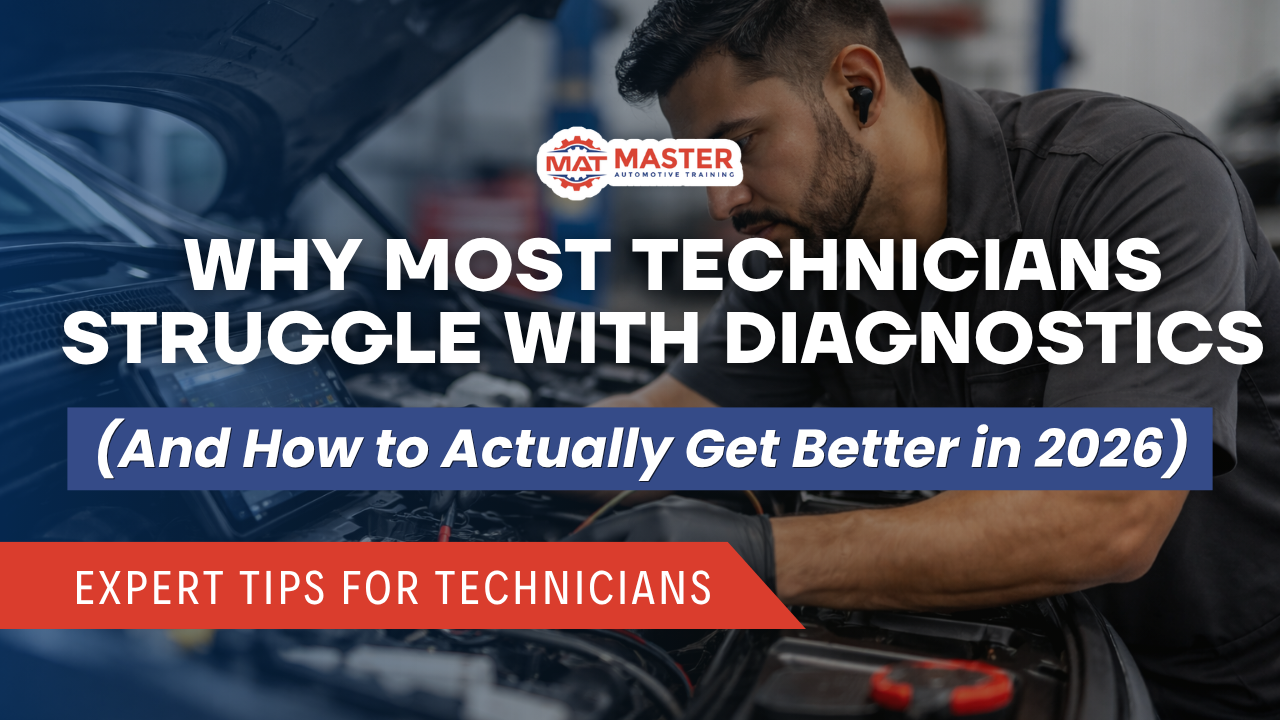
Diagnostics can be frustrating.
You plug in the scan tool…
You get a code…
You replace what seems like the obvious part…
And the problem is still there.
Now you’ve got time lost, a frustrated customer, and you’re second-guessing everything.
If that sounds familiar—you’re not alone.
The Real Problem (That Nobody Talks About)
It’s not that technicians aren’t trying.
Most techs are working hard every day.
The real issue is this:
👉 A lot of technicians were never shown how to diagnose properly.
They were taught:
- How to pull codes
- How to replace parts
- How to follow patterns
But not how to actually think through a problem from start to finish.
And in 2026—that’s exactly what this job requires.
Where Things Usually Go Wrong
Let’s break down what’s actually happening in the shop.
1. Relying Too Much on Codes
Codes help—but they don’t tell the whole story.
You already know this if you’ve ever:
- Replaced an O2 sensor and the code came back
- Chased a lean condition that wasn’t actually fuel-related
- Seen multiple codes that didn’t even seem connected
Codes point you in a direction.
They don’t give you the answer.
2. Guessing Instead of Testing
This is where things get expensive.
It usually starts with:
“I’ve seen this before… it’s probably this.”
Sometimes that works.
But with newer vehicles? Not anymore.
Without testing, you’re just hoping—and hope doesn’t fix cars consistently.
3. Electrical = Confusion
A lot of technicians hit a wall here.
Not because they’re not capable—but because:
- It wasn’t taught clearly
- It was rushed during training
- Or it was made to seem harder than it really is
So instead of testing… they avoid it.
But here’s the reality today:
👉 Most of the tough problems are electrical or communication-related.
4. No Clear Process
This is probably the biggest issue.
Without a step-by-step approach, diagnostics turns into:
- Jumping between ideas
- Trying random tests
- Getting lost halfway through
That’s when frustration kicks in.
What Better Technicians Do Differently
If you watch a strong diagnostic tech, you’ll notice something right away:
They’re not guessing.
They’re following a process.
They Confirm the Problem First
Before touching anything, they:
- Verify the concern
- Recreate the issue
- Make sure they understand what’s actually happening
Sounds simple—but this step gets skipped all the time.
They Look at Data—Not Just Codes
Instead of jumping to conclusions, they ask:
👉 “What is the car telling me right now?”
They’re checking:
- Fuel trims
- Sensor readings
- System behavior
That’s where the real answers are.
They Test Before Replacing Anything
Good techs don’t assume—they prove.
They use:
- Multimeters
- Scan tools
- Sometimes scopes
Not in a complicated way—just enough to confirm what’s actually wrong.
They Keep It Simple
This is important.
Good technicians don’t overcomplicate diagnostics.
They break it down:
- What should be happening?
- What’s actually happening?
- What’s causing the difference?
That’s it.
Why So Many Techs Feel Stuck
It’s not about intelligence.
It’s not about effort.
It usually comes down to this:
- Learning through trial and error
- No structured training
- Doing things the same way for years
But the cars changed…
…and the approach didn’t.
What Actually Helps You Improve
It’s not more guessing.
It’s not more parts swapping.
It’s learning how to:
- Read data properly
- Understand system behavior
- Follow a repeatable process
And most importantly…
👉 Knowing why you’re doing each step.
What Training Should Look Like Today
If training doesn’t help you in the shop, it’s not useful.
Good training in 2026 should:
- Use real-world examples
- Show actual diagnostic steps
- Explain things simply
- Focus on testing—not theory overload
Because at the end of the day…
You don’t need more information.
You need something you can actually use Monday morning.
Final Thought
Every technician struggles with diagnostics at some point.
The difference is:
Some stay stuck…
Others figure out a better way to approach it.
If you learn how to diagnose properly:
- The job gets easier
- You fix cars faster
- You stop second-guessing yourself
That’s when everything starts to change.
Ready to Get Better at Diagnostics?
If you’re serious about improving your diagnostic skills, check out Smart Automotive Training.
We focus on:
- Real-world testing
- Simple, repeatable processes
- Skills you can actually use in the shop
👉 Not near us?
https://masterautomotivetraining.podia.com/
We don’t teach fluff.
We teach what works.