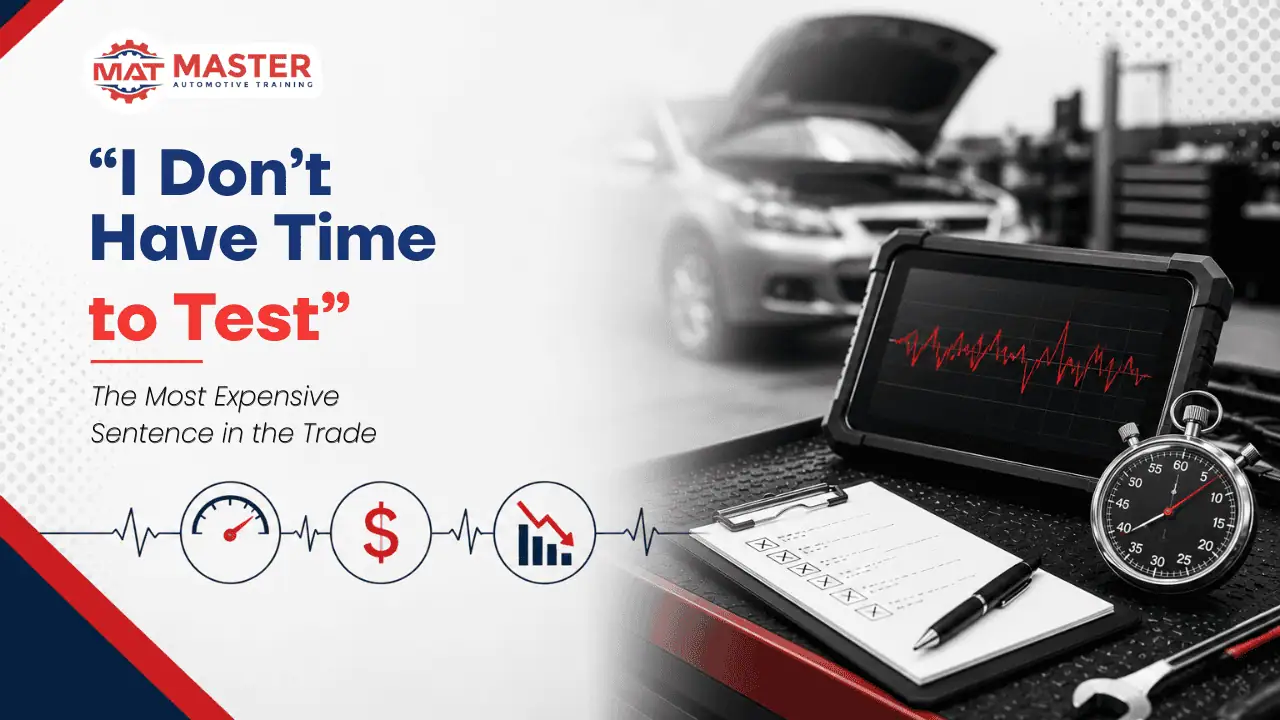
“I Don’t Have Time to Test” — The Most Expensive Sentence in the Trade
You’ve said it. So have I.
Tech walks up to the advisor, hands over the keys, says it runs fine now. Or hands the customer back the car after replacing the part that “had to be it.” Or argues with the owner that the diag fee isn’t worth the time it takes to charge it.
“I don’t have time to test.”
It feels true. The bay is full. The clock is moving. The next car is sitting there with its own complaint. Testing feels like it would slow everything down.
And then the car comes back.
1. The Sentence Has a Hidden Math Problem
Here’s what nobody works out when they’re saying it.
Time to test the right way: usually 15 to 30 minutes. Sometimes less. A scope capture is 60 seconds. A three-PID graph during a test drive is no extra time at all — you were already driving the car.
Time for the comeback: hours.
That’s not a comparison. That’s a fight nobody should be taking. And it’s the easy version, because the comeback also costs you:
- The labor on the original repair — gone
- The part you installed — sometimes you eat it, sometimes the supplier does, never the customer
- The advisor taking an angry phone call instead of selling the next ticket
- The Google review that doesn’t say “they got it the first time”
- The customer who never comes back
Testing once is always faster than fixing it twice.
There’s no version of the math where guessing wins.
2. Why It Feels True Anyway
The “no time to test” lie has a real source. Most of the time it’s not laziness — it’s load.
The tech is buried. The shop is understaffed. The advisor needs an answer in the next ten minutes because the customer is waiting. The owner is on everyone about car count.
In that environment, testing feels like a luxury. Throwing the most likely part feels like the move.
It isn’t. It’s just the move that postpones the cost. The comeback always arrives. The only question is whether it shows up today (when you tested) or next week (when you didn’t).
Guessing doesn’t save the time. It just moves it.
3. The Shops That Test Fast Aren’t Faster Guessers
A shop that tests fast has systems.
The scan tool is plugged in before the car gets backed in. The scope is mounted on the cart and the channels are pre-labeled. The diagnostic worksheet has three boxes — captured, analyzed, conclusion — and the tech checks them as they go. The advisor knows the diag fee policy and sells it without flinching.
That shop isn’t spending more time per car. It’s spending the same time per car — but the time goes into proving the fault instead of cleaning up a guess.
You either spend the time proving the fault. Or you spend more time cleaning up your guess.
You don’t get to skip the time. You only get to choose where it lands.
4. Pros vs. Guessers
Every senior tech you respect tests first. Ask them why. They’ll tell you the same story: they used to guess. They got burned enough times to stop.
That’s the entire career arc compressed into one habit change.
The pro doesn’t test because they love testing. They test because they hate comebacks more. They hate explaining themselves to the advisor. They hate the customer’s voice on the phone. They hate watching a car they already worked on roll back onto the lift.
A guesser stays busy. Cars in, parts out, cars back, parts out again. The bay is always full and the bank account never grows, because half the hours are unpaid rework.
A pro stays paid. Cleaner diagnoses, repeat customers, advisors who trust them, owners who promote them.
Pros test first. Guessers stay busy by fixing the same car twice.
That’s the choice. Made every day, on every job, with every customer.
5. What “Testing” Actually Costs You in Minutes
The myth is testing eats your day. The math says testing is fast.
- A relative compression test: 90 seconds with a scope and an amp clamp
- A fuel pressure check at idle and WOT: about 5 minutes
- A three-PID graph capture on a test drive: 0 extra minutes (you were driving)
- An O2 sensor waveform check: 60 seconds
- A scan-tool freeze-frame review: under a minute
Add them up across a normal drivability complaint and you’re at 10 to 15 minutes. The wrong part takes longer than that to order, install, and pull back out.
The myth is testing slows you down. The math is comebacks slow you down.
6. A Note for Shop Owners
If your techs are saying “I don’t have time to test,” the problem isn’t on the bay floor. It’s in the workflow.
Build the test in. Make the diag fee non-optional and sell it. Get a proper scope on a rolling cart. Give your top tech 30 minutes to write a one-page diagnostic checklist for the five complaints you see most. Enforce it.
Shops that do this don’t have a comeback rate. They have a referral rate.
The Bottom Line
“I don’t have time to test” is the most expensive sentence in any shop. It costs the tech their reputation. It costs the advisor their pitch. It costs the owner the comeback hours that never get billed.
Testing once is always faster than fixing it twice. Pros test first. Guessers stay busy.
Testing, not guessing. That’s the standard.
Master Automotive Training runs the courses that teach techs how to test fast — automotive diagnostics, scope and pattern work, EV/Hybrid (L3), and more. The shops that send their teams come back asking when the next class is.
Bettering the automotive industry one technician at a time.