
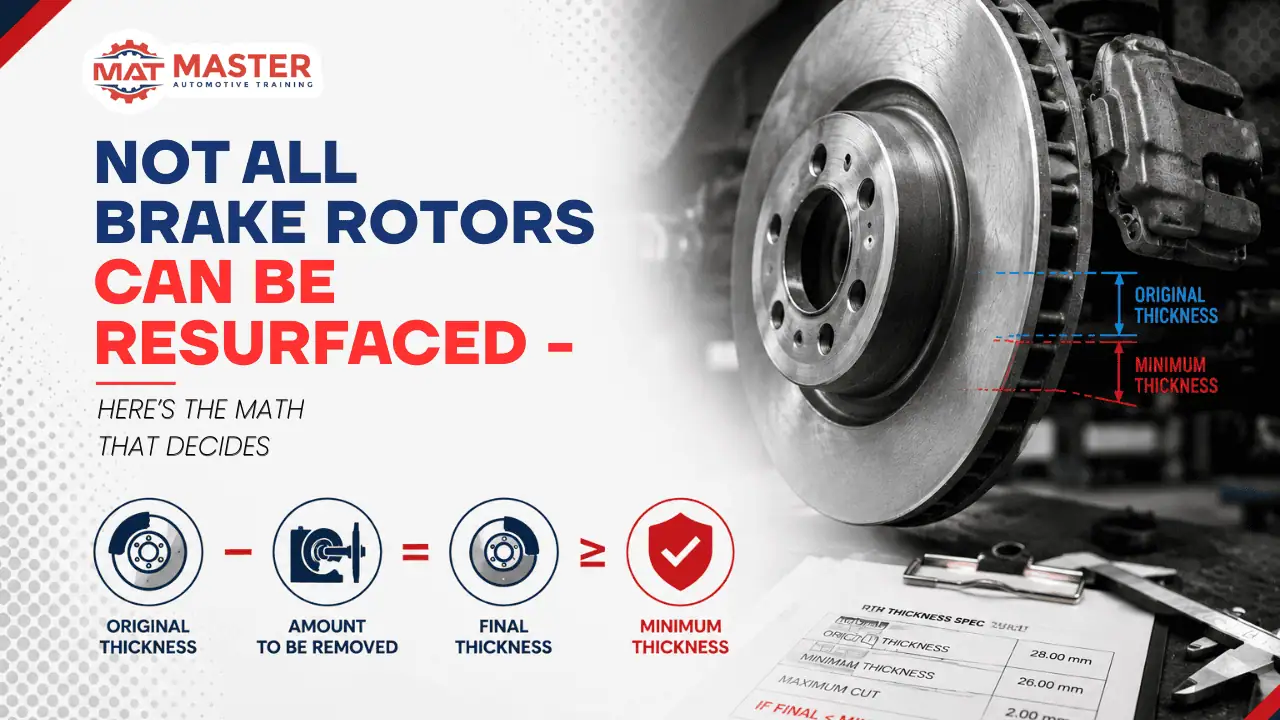
Not All Brake Rotors Can Be Resurfaced — Here’s the Math That Decides
Your shop just told you the rotors need to be replaced.
You remember when a rotor was something you turned. The tech pulled it off, put it on a lathe, cut it fresh, put it back on. Two rotors and a set of pads and you were out the door.
Now the recommendation is replacement. Not machining. And the ticket is bigger.
Before you assume it’s an upsell, run the same math the shop just did. There’s a reason modern rotors often can’t be reused, and it’s not price. It’s physics.
1. What a Brake Rotor Actually Is
A brake rotor is the metal disc your pads clamp onto every time you brake.
Every stop generates friction. Friction generates heat. And a small amount of metal transfers between the pad and the rotor on every single application — the rotor is wearing on every stop, forever, whether you notice it or not.
A brake rotor is a wear item pretending to be a permanent part.
The manufacturer knows this. That’s why they stamped a number into the rotor when they made it.
2. The Number Stamped on the Rotor
Look at the edge of any modern brake rotor. Somewhere near the hat or the outer edge, you’ll find a number cast into the metal — usually labeled MIN, DTV, or “discard.”
That’s the minimum allowable thickness. The point at which the manufacturer says this rotor can no longer safely do its job.
Below that number, the rotor can’t absorb heat properly, can’t hold shape under braking load, and can crack, warp, or fail. That’s not a “recommendation.” That’s a spec.
The number stamped on the rotor isn’t a suggestion. It’s the point where the manufacturer says it stops being safe.
3. The Math on a Real Car
Let’s do the actual math on a 2010 Ford Focus, because the numbers make the whole issue clear.
According to Ford’s service information:
- New rotor thickness: 22 mm
- Discard thickness: 20 mm
- Total wear allowance: 2 mm
That’s it. Two millimeters — less than the thickness of two stacked business cards — is the entire lifespan the manufacturer built into this rotor from new to worn out.
Now here’s where the trouble starts.
4. Why Machining Often Isn’t an Option
When a rotor is machined — resurfaced on a lathe — the cutting bit has to remove a minimum of 0.4 to 0.5 mm per side just to properly clean up the friction surface. Anything less and the cut doesn’t fully clean up the grooves, scoring, and glazing left by years of use.
That’s 0.8 to 1.0 mm removed in one machining — half the entire wear allowance the rotor was built with.
Now add a real-world condition: parallelism.
A rotor with uneven thickness — even a few thousandths of variation from one point to another — causes the pedal to pulse when you brake. Fixing that on the lathe means removing even more material to bring the two sides back into parallel.
Put it all together:
- Rotor measures 21 mm (above the 20 mm minimum)
- Machining will remove roughly 1 mm
- New measurement after machining: 20 mm — at the discard limit before the pads have made a single stop
The math has to work. On a lot of modern vehicles, it doesn’t.
5. What This Means When You Get the Recommendation
A rotor reading above the discard limit isn’t automatically a candidate for machining. The right question isn’t is it above the minimum right now? — it’s will it still be above the minimum after the cut, with enough life left to make the machining worthwhile?
A shop worth its bay time is doing that math before they quote you anything. When they come back with “replacement, not machining,” they’re not choosing the more expensive option to pad the ticket. They’re choosing the only option the math left them.
Here’s how to test whether the recommendation is honest:
- Ask what the discard thickness is for your vehicle
- Ask what your rotor actually measured
- Ask how much material a machining pass would remove
If they can answer all three off the top of their head, they measured. If they can’t, they’re guessing — and that’s a different conversation entirely.
6. Why Modern Rotors Are Thinner in the First Place
Fair question. The rotors on your grandfather’s Chevy were thick, heavy castings that could go through three or four machining cycles in their life.
Today’s rotors are engineered lighter and thinner — partly for fuel economy, partly for reduced unsprung weight, partly for cost. That engineering left less meat on the bone. Better braking performance, worse serviceability. That trade-off is real.
The days of turning a rotor twice before replacing it are largely over. The math changed because the parts changed.
The Bottom Line
Brake rotors have a life stamped into them from the factory. Modern vehicles often left barely enough margin for one machining, if any. Sometimes the numbers work. Often, on modern cars, they don’t.
A shop that measures before it recommends is a shop that respects you. A shop that quotes “replace” without ever pulling out a micrometer is guessing — and so is a shop that just quotes “machine” without checking whether the math even works.
If you’re in Rancho Cucamonga and you want brake work done by a shop that measures first, tells you the numbers, and only recommends what the math actually supports, Master Auto Care runs that way on every brake job that comes in.
Honesty drives, and safety thrives.