
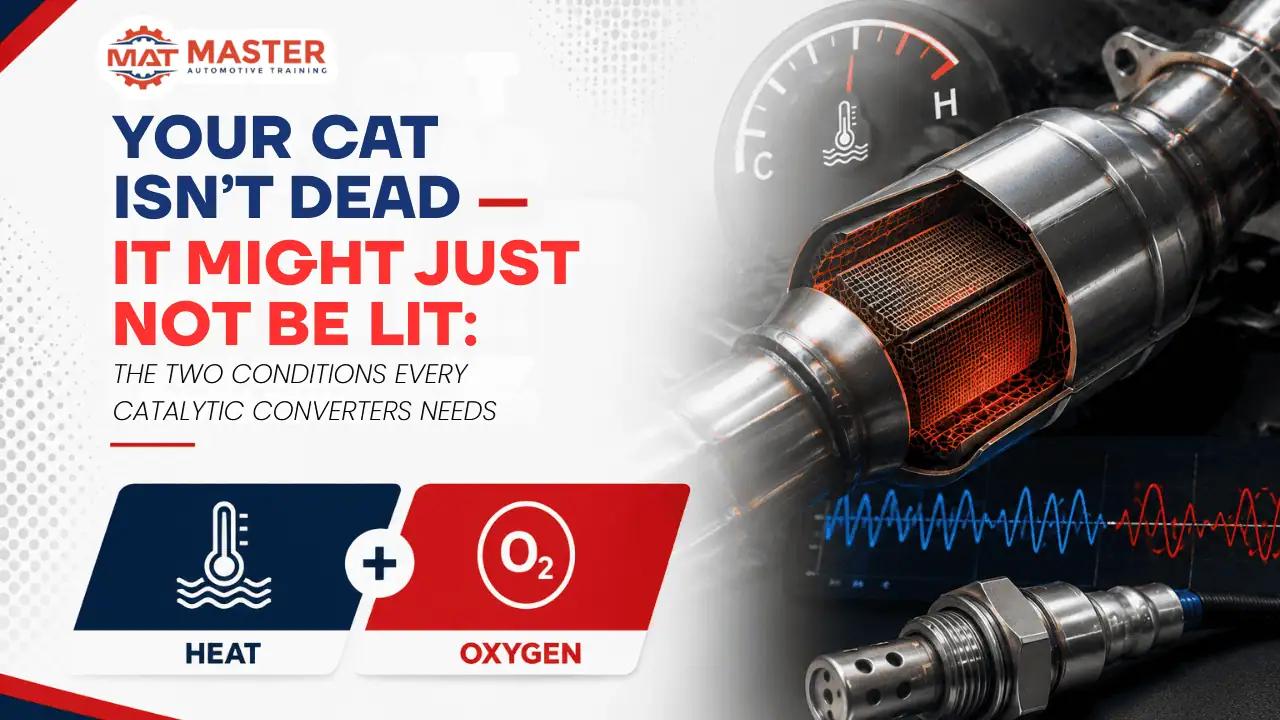
Your Cat Isn’t Dead — It Might Just Not Be Lit: The Two Conditions Every Catalytic Converter Needs
In the first post of this series, we ran the RPM test on a P0420 diagnosis. Graph both O2 sensors, raise the engine to 2500 and 3500 RPM, and watch what the downstream signal does. If it stabilizes as RPM climbs, the cat isn’t necessarily dead — it may just not be lit.
The question a lot of techs asked after that: why does the RPM test actually work?
Here’s the answer. And once you understand it, P0420 stops being a “replace the cat” conversation and starts being a “which kind of cat problem is this?” conversation.
1. A Catalytic Converter Isn’t a Filter — It’s a Reactor
The mental model most techs (and every customer) carry is that a cat is basically a filter. Dirty exhaust in, clean exhaust out.
That’s not what’s happening.
A three-way catalytic converter is a chemical reactor. Precious metals — platinum, palladium, rhodium — coat a ceramic honeycomb substrate. Exhaust gases pass over that coating and chemical reactions convert:
- Hydrocarbons (HC) → water and carbon dioxide
- Carbon monoxide (CO) → carbon dioxide
- Oxides of nitrogen (NOx) → nitrogen and oxygen
Those reactions don’t happen at any temperature and any mixture. They happen inside a specific window. Outside it, the cat is present — but not converting.
A cat doesn’t clean exhaust. It runs a reaction. Reactions need conditions.
2. Condition One — Temperature
The first condition is heat. The cat has to reach its light-off temperature — the point at which the chemistry actually kicks in.
For most three-way converters, light-off is somewhere between 400°F and 600°F. Normal operating range is 500°F to 800°F. Below that floor, the coating is inert. Exhaust flows through the substrate untouched.
Here’s where it gets diagnostic.
At idle on a cold engine, exhaust temperature at the cat is low. On a healthy, thermally-massive cat with a well-tuned engine, that’s not usually a problem — the cat stores enough heat from operating cycles to stay lit through short idle periods.
On a marginal cat, or on an engine with weak combustion, exhaust temperature at idle can drop below light-off. The cat is right there in the pipe. It just isn’t running the reaction anymore.
Raise the RPM. Exhaust flow goes up, exhaust temperature climbs, the cat re-enters its operating window, and the downstream O2 sensor smooths out — because the reaction started again.
A cat that fails at idle and works at 3500 RPM isn’t broken. It’s cold.
3. Condition Two — Air-Fuel Ratio
The second condition is what’s inside the exhaust when it hits the cat.
A three-way catalyst can only convert all three pollutants — HC, CO, and NOx — simultaneously when the air-fuel ratio arriving at the substrate stays very close to stoichiometric: lambda 1.0, plus or minus about 1%.
Miss that window in either direction and the cat loses efficiency on at least one pollutant:
- Lean of stoich: plenty of oxygen for HC and CO oxidation, but NOx reduction fails
- Rich of stoich: NOx conversion works, but there isn’t enough oxygen left to burn off HC and CO
The reason the PCM works so hard to keep short-term fuel trim swinging tight around lambda 1.0 isn’t just emissions compliance. It’s that the cat is a chemistry problem, and the chemistry only works inside that narrow envelope.
Stoichiometric fuel control isn’t for the engine. It’s for the cat.
4. Why the RPM Test Works
Now the pieces snap together.
When you raised the RPM in the Part 1 test, you didn’t magically fix the cat. You changed two conditions at once:
- Exhaust temperature climbed — bringing a cold or marginal cat up to light-off
- AFR held tight around stoich under steady throttle — giving the chemistry what it needs to run
If the downstream O2 flattens as those conditions come together, the catalyst chemistry is there. The reaction is possible. What’s missing is one of the operating conditions — and that means the real fault lives somewhere else.
Somewhere upstream of the cat, something is preventing normal operating temperature at idle. Could be:
- A thermostat stuck open (engine can’t fully warm up)
- Extended open-loop from CTS/ECT drift or wiring
- Weak combustion — worn plugs, coils, low compression
- An exhaust leak ahead of the cat cooling the flow
- A fuel trim issue keeping AFR outside the stoich window at idle
Replace the cat with any of those unfixed, and the same code sets again in three weeks.
5. What Actually Kills a Cat Permanently
There’s a second class of failure where the cat can’t be saved — no matter what you fix upstream.
Thermal damage. A misfire dumps unburned fuel into the cat, where it ignites on the hot substrate. Internal temperatures can exceed 2000°F. The substrate melts, cracks, or collapses. No upstream repair brings the honeycomb back.
Chemical poisoning. Phosphorus from burning oil and silicates from leaking coolant coat the washcoat and block the precious metal sites. The chemistry can’t happen if the reactants can’t reach the surface. Poisoning is permanent.
A cat that’s cold can be saved. A cat that’s melted or poisoned cannot.
Two very different diagnoses. Two very different repair orders.
6. What This Means for Every P0420
Every P0420 that hits your bay is now three questions in sequence:
- Is the cat efficiency actually failing at idle? (Run the graph test from Part 1.)
- Does it recover at higher RPM? (Run the RPM sweep.)
- If it doesn’t recover — is there evidence of thermal or chemical damage? (Check history for misfires, oil consumption, coolant loss.)
The answers tell you whether you’re writing an upstream repair, a converter replacement, or both.
The Bottom Line
A P0420 tells you the PCM decided the cat wasn’t doing its job. It doesn’t tell you why. And “why” is the difference between a $150 upstream repair and a $1,500 converter — sometimes on the same car.
Cats are reactors. Reactors need conditions. Confirm the conditions before you condemn the part.
Master Automotive Training teaches this level of diagnostic reasoning across the full curriculum — automotive diagnostics, graph and scope work, EV/Hybrid (L3), and more. Real cases. Real bays. Real learning.
Bettering the automotive industry one technician at a time.