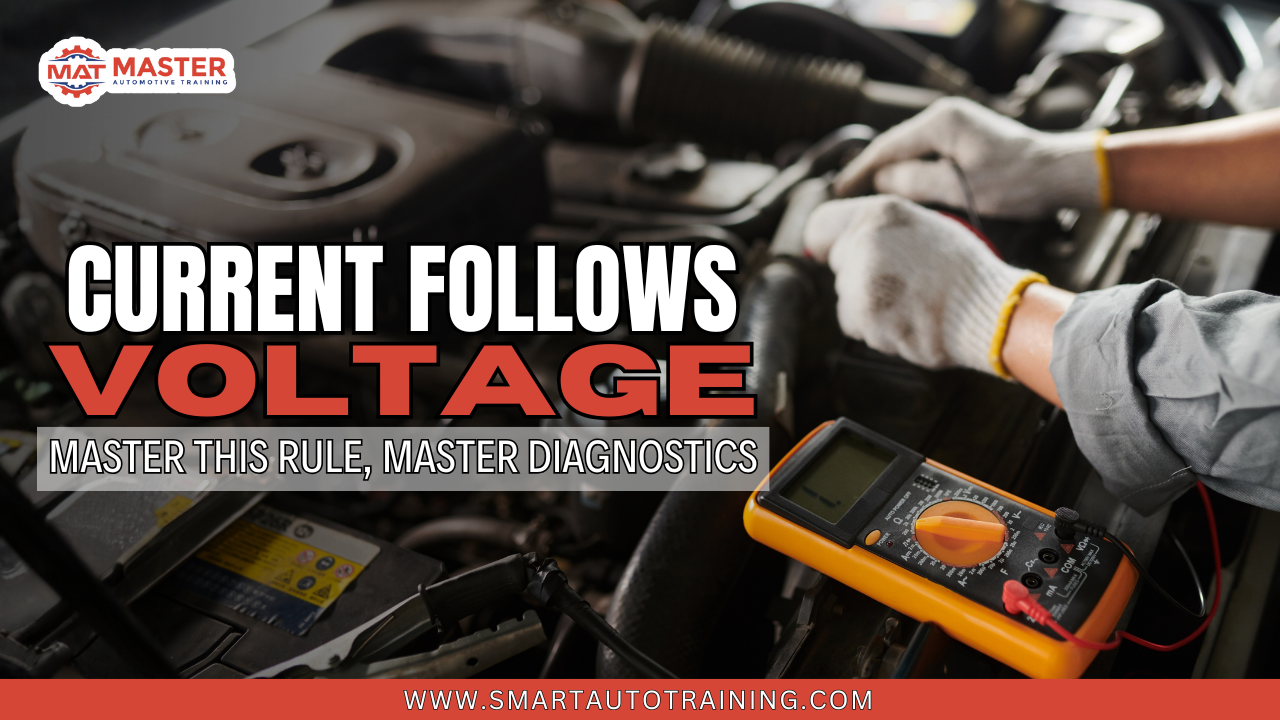
If there’s one principle every aspiring technician must understand early on, it’s this: current follows voltage. Wherever voltage goes, current follows—like a shadow. No voltage? No current. It’s that simple.
Yet this simple rule can completely change how you approach electrical diagnostics in the shop.
Why Voltage Matters More Than You Think
Let’s make it practical. Imagine you’re troubleshooting a fuel pump, headlight, or cooling fan. When the component receives low voltage, the current drops as well.
Here’s what usually happens next:
- The headlight looks dim.
- The fan spins slower than normal.
- The pump sounds weak or inconsistent.
Now, here’s the key takeaway: the component itself might not be defective. It could be perfectly fine—but if it’s getting low voltage because of a corroded connector, poor ground, or bad aftermarket wiring, then current flow suffers.
The Problem Isn’t Always the Part
Too many technicians replace parts that were never bad to begin with. They see weak performance and assume failure. But a smarter diagnostic approach starts with one step: check the voltage first.
When you verify that proper voltage reaches the component, you let it perform as designed. If voltage is solid and it still fails, replacement might be justified. But if voltage is low, fix the power supply issue before blaming the part.
This method saves time, reduces comebacks, and makes you a more trusted technician.
Ask Smarter Questions During Diagnosis
Many technicians focus only on current measurements. However, the most skilled techs understand that voltage reveals the real story.
Think of it this way:
- Current shows how much is flowing.
- Voltage shows why it’s flowing—or why it isn’t.
When you check both voltage and current, you see the complete electrical picture. This approach helps you fix the root cause instead of chasing symptoms.
Golden Nugget of the Day
“A lazy tech checks current.
A smart tech asks: ‘What’s the voltage feeding that current?’”
Always start with voltage. Most electrical problems begin—and end—there.
Learn Smarter Diagnostics at Smart Auto Training
At Smart Auto Training, we teach technicians to stop guessing and start testing with purpose. Our hands-on automotive electrical courses cover real-world diagnostics, including:
- Voltage and current relationship testing
- Load testing for accurate results
- Identifying hidden wiring and connection issues
These lessons build the foundation for confident diagnostics and fewer costly comebacks.
Ready to Level Up?
If you’re serious about growing your automotive career, this is the time to invest in your skills. Learn to think like a diagnostic professional—from day one.
👉 Explore our programs: www.SmartAutoTraining.com
📞 Call us: 909-539-0114
Master the relationship between voltage and current, and you’ll master diagnostics for life.