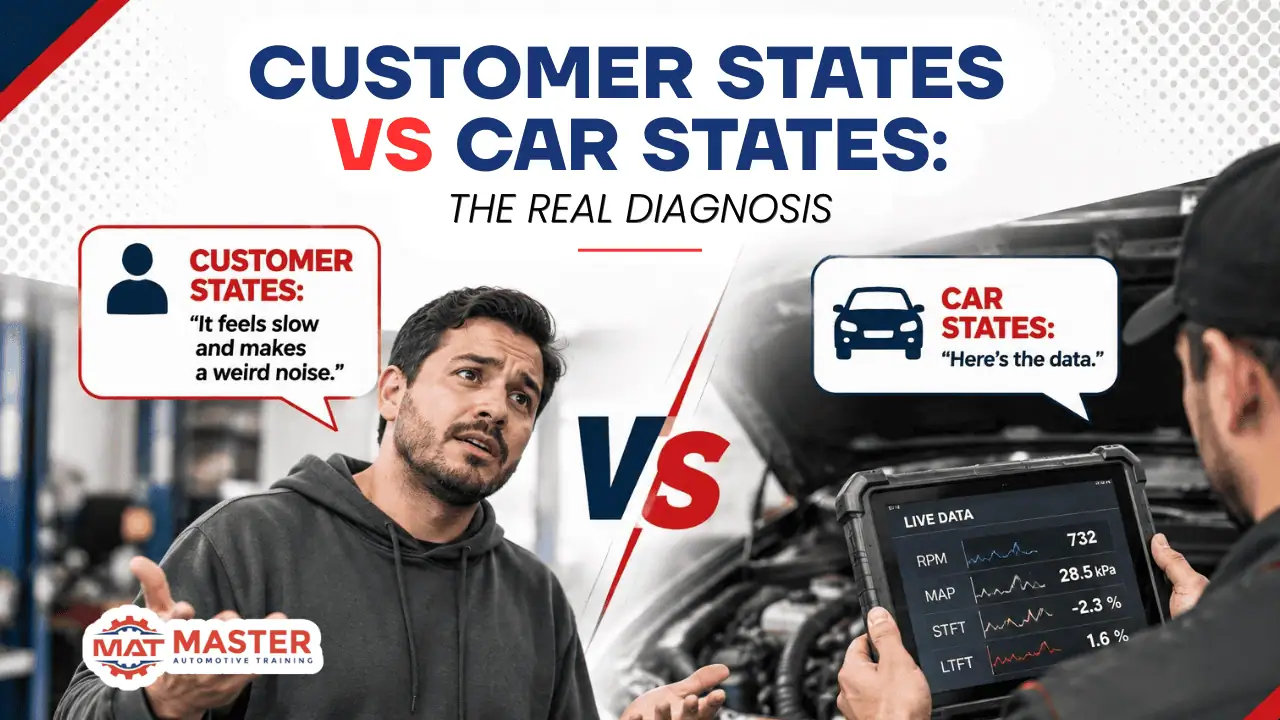
Customer States vs Car States: The Real Diagnosis
Every intake starts the same way. Customer states the car is making noise. Customer also states it only does it sometimes. Then the customer states it was fine until another shop touched it.
Let me show you what the car states when we actually test it.
That gap — between what the customer states versus what the car states — is where most misdiagnoses live, most trust gets built or broken, and where the difference between a real shop and a parts-swapping shop becomes visible.
Here’s how to read both.
1. What the “Customer States” Format Actually Captures
If you’ve written repair orders in California or anywhere else in the country, you already know the format. Every complaint gets logged in the customer’s words: customer states rough idle, customer states loss of power on the highway, customer states check engine light came on after fill-up.
That’s not filler language. It’s doing three jobs at once:
- Legal. It documents exactly what the customer reported at intake, protecting the shop if the story changes later.
- Communication. It captures the words the customer used, so the tech isn’t guessing at translation.
- Diagnostic. It gives the tech a starting point — a symptom, timing, and context — before the vehicle is even opened.
I love the “customer states” format because it captures something real. But it captures one specific thing: what the customer experienced. Not what’s actually happening in the vehicle. Those are two different conversations, and mixing them up is how good shops start writing bad repairs.
2. Why the Two Conversations Almost Never Match
The customer describes an experience. What they felt. What they heard. What another shop told them. What their neighbor’s cousin who used to work at a dealership diagnosed over the phone.
The car communicates something else entirely. It reports what’s measurable, testable, and verifiable — voltages, pressures, waveforms, pad thicknesses, fluid conditions, code histories.
Neither of those two languages is wrong. They’re just different levels of the same situation. The customer is describing the symptom. The car is describing the fault. And when you stack them side by side, the picture almost always looks like this:
3. Four Real Examples
Customer states the brakes feel fine. The car states the front pads are at 2 mm and the passenger-side caliper is seized.
Customer states the car just needs a tune-up. The car states there’s a misfire on cylinder 3 caused by oil intrusion into the spark plug well from a leaking valve cover gasket.
Customer states the battery is new. The car states the charging system is putting out 12.4 volts at idle and the alternator is failing.
Customer states the other shop said it was the sensor. The car states the sensor is fine, the wiring harness is chaffed, and it’s causing an intermittent ground fault.
Four intakes. Eight completely different conversations. In every one of them, the customer wasn’t lying — they were reporting exactly what they knew. And in every one of them, the actual repair looked nothing like what the customer thought they were bringing the car in for.
4. The Customer Isn’t Lying
This is the part of the mindset most shops get wrong.
When the customer story doesn’t match the car, it’s tempting to assume the customer is confused, mistaken, or being difficult. That’s the frustrated-tech reflex, and it’s the wrong one.
The customer isn’t lying. They’re describing what they experienced.
They’re not equipped to measure fuel pressure. They can’t read a scope. They don’t know that a solid brake pedal doesn’t mean the pads are healthy. They’ve never seen a graph of a MAP sensor stall out at 90 kPa when it should be crossing 150. They’re doing the best they can with the information they have — which is exactly what any driver would do.
Your job isn’t to grade the customer’s diagnosis. Your job is to hear the symptom, document it accurately, and then let the vehicle answer the question independently.
5. Listen to Both — Trust the One With More Data
Both conversations matter. The customer’s account gives you the when — when the symptom started, when it happens, when it doesn’t. That’s data. It narrows the search. Discarding it is a mistake.
But the vehicle’s account gives you the what — measurable, testable, repeatable evidence of the actual fault. That’s the data that dictates the repair.
The move is to listen to both and trust the one with more information. Almost always, that’s the vehicle. The customer told you the light came on after fill-up. That’s a real clue. But the fuel trim data, the scan tool freeze frame, the tank pressure trace under drive cycle — that’s the diagnosis.
Our job is to listen to both, then diagnose the car and take it from there.
6. Why This Matters for Every Shop
Running your intake this way pays off in four ways at once:
- Legal protection. The RO documents both what the customer stated and what your inspection found. If the story changes, the paperwork tells the truth.
- Customer trust. They watch you take their words seriously and test independently. Neither dismissed nor rubber-stamped. That’s the shop they come back to.
- Cleaner diagnoses. You don’t get anchored to the customer’s theory. You test what the vehicle needs tested, not what the customer said they’d already fixed.
- Better tech culture. Techs stop rolling their eyes at customer stories and start using them as inputs to the diagnosis. Different reflex, different outcome.
Every one of those compounds over hundreds of repair orders a year. Shops that run this way finish more jobs correctly the first time, argue with fewer customers, and defend fewer complaints to the Bureau.
The Bottom Line
The customer states what they felt. The car states what’s true.
Both are worth listening to. Only one comes with data. Diagnose the vehicle, respect the customer, document both — and take the repair from there.
Master Automotive Training teaches the intake and diagnostic disciplines that separate real shops from parts-swappers — automotive diagnostics, graph mode and scope work, service advisor systems, EV/Hybrid (L3), and more.
Bettering the automotive industry one technician at a time.