
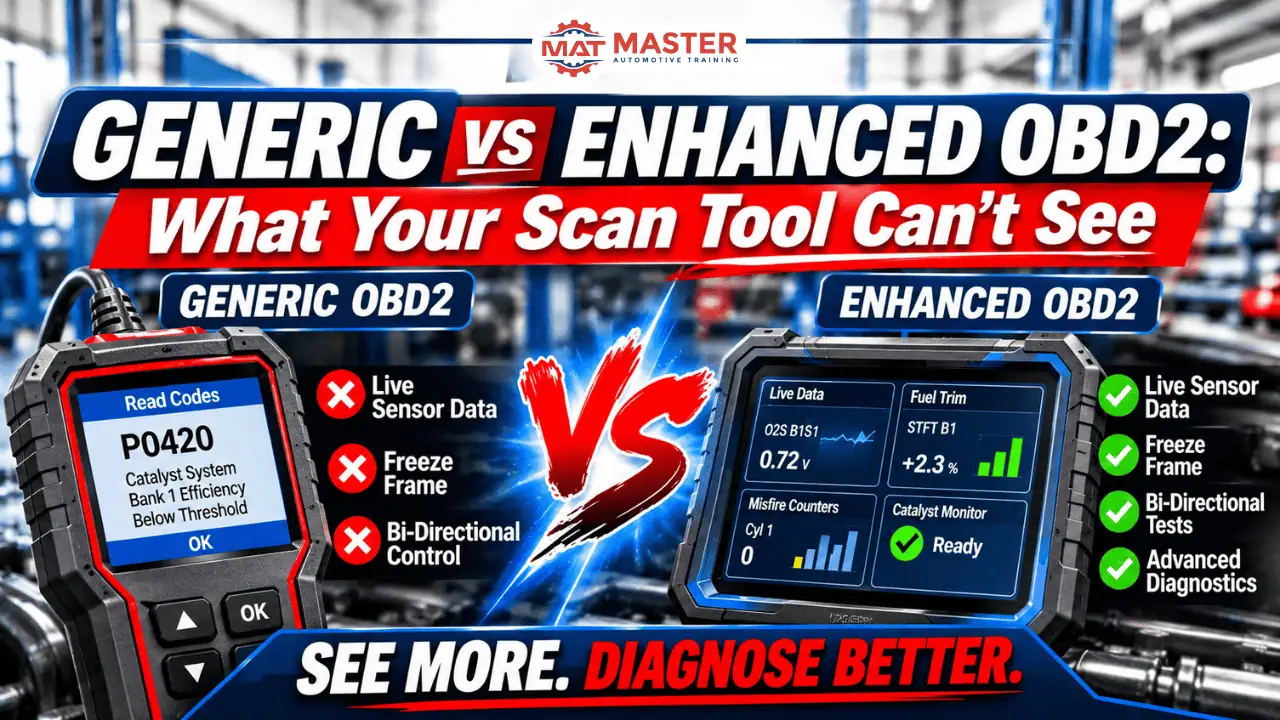
Generic vs Enhanced OBD2: What Your Scan Tool Can’t See
You plug in, pull codes, watch live data. The generic screen looks clean. No pending faults. Fuel trims in range. Coolant temp climbing normally. But the customer complaint is still on the ticket — and you’re still no closer to a diagnosis.
Here’s what a lot of techs miss: the data on that generic screen is a starting point, not a complete picture.
Generic vs enhanced OBD2 is not the same conversation, and it never was. Every diagnosis you make on a modern vehicle is shaped by which of those two data sets you’re actually looking at. Here’s what the generic port shows you, what it doesn’t, and why the difference matters on every job.
1. What Generic OBD2 Actually Is
Generic OBD2 is defined by SAE J1979. It’s the federal minimum every OBD2 vehicle has to provide, and every scan tool in the world can read.
The standard defines nine modes of communication (Modes 1 through 9), and roughly 80 standardized PIDs. You know the important ones by heart: engine RPM, coolant temperature, fuel trim, O2 sensor voltage, MAP, MAF, calculated load, freeze frame data. Every OBD2 vehicle broadcasts these. Every scan tool speaks the same language back.
That standard exists for one reason: emissions compliance. Generic OBD2 was built so any inspector, in any state, could plug into any car and confirm the emissions systems were working. It was never designed to give you the whole vehicle.
Generic OBD2 is the emissions floor. It was never meant to be the ceiling.
2. What Generic OBD2 Actually Sees
The generic port gives you the powertrain and emissions systems. That’s it.
Specifically, you can pull:
- Live PIDs from the ECM/PCM
- Stored, pending, and permanent DTCs — but only P-codes related to emissions
- Freeze frame data at the moment a monitor set a code
- Readiness monitor status
- O2 sensor test results
- On-board monitor data
That’s a real toolkit for anything that trips an emissions warning. It’s exactly the toolkit that lets a smog station confirm compliance in six minutes. What it isn’t is a complete look at a modern vehicle with 30-plus modules on the network.
3. What Generic OBD2 Cannot See
This is the part that catches techs by surprise. Everything below is running on the car right now, and generic OBD2 shows you almost none of it:
- Transmission data beyond emissions-related shift events
- ABS module data, wheel speed sensors, hydraulic pressure
- Stability and traction control
- Body Control Module — the brain behind doors, windows, exterior lighting
- HVAC and climate control modules
- Airbag and safety restraint system
- Any B, C, or U code — body, chassis, or network communication faults
Generic gives you emissions-related powertrain. Every other module on the vehicle is behind the manufacturer wall — reachable only if your scan tool has enhanced access.
Generic OBD2 sees one module. Enhanced sees the whole network.
4. What Enhanced (Manufacturer-Specific) Data Gives You
Enhanced access is the OEM’s own diagnostic language, layered on top of the OBD2 physical connection. Once your scan tool has the software to speak it for a given brand, the data set expands dramatically:
- Hundreds of additional PIDs per module — not 80 total for the car, but 80-plus for each of a dozen modules
- Bi-directional control — command an actuator, run a functional test, cycle a solenoid on demand
- Enhanced code definitions — more precise fault descriptions than the generic P-code text
- Live data from every module on the network — transmission, ABS, BCM, HVAC, airbags, and everything else
- Network status — a real view of the bus itself, showing which modules are online, which aren’t, and which are communicating slowly
That’s the difference between reading one page of the story and reading the whole book.
5. The Real-World Difference — A No-Start With U-Codes
Here’s the diagnostic scenario where the gap becomes impossible to ignore.
A vehicle comes in on a no-start. You pull a generic scan and see a handful of U-codes: network communication faults. U0100, U0121, U0140 — modules aren’t talking to each other. Generic OBD2 has told you something is wrong on the bus, but it can’t tell you which module actually dropped off.
Now hook up a manufacturer-specific scan tool with the right software. The network view populates. You can see every module that’s supposed to be online, which ones are answering, which ones are silent, and how the traffic is flowing across the bus.
Suddenly the diagnosis moves from “somewhere on the network” to “the BCM isn’t answering, the ABS is intermittent, and the gateway is dropping requests.” That’s not the same job. That’s a completely different repair order.
Generic OBD2 tells you the network has a problem. Enhanced tells you which module isn’t answering the phone.
6. When to Use Which
Both have a place. The mistake is defaulting to one when the diagnosis needs the other.
Reach for generic when:
- You need a quick emissions readiness check before a smog test
- The complaint is emissions-related and P-codes have already set
- You need a universal, brand-agnostic starting point
Reach for enhanced when:
- The code starts with B, C, or U
- The complaint involves anything beyond powertrain
- There are intermittent modules or communication faults
- You need bi-directional control to run a functional test
- You want live data from a specific non-powertrain module
Most real diagnoses touch both. Start generic for the P-code floor, move to enhanced the moment the scenario asks for more depth.
7. The Habit Worth Building
Every time you hook up a scan tool, know what data you’re actually looking at. Is that fuel trim number coming from the generic PID list or from the enhanced ECM data? Is that missing module a real drop-out on the bus, or is your generic tool just not asking the right questions?
The tool you’re using shapes the diagnosis you make. When you don’t know which mode you’re in, it’s easy to miss what’s really there — or chase what isn’t.
The Bottom Line
Generic OBD2 is the standard. Enhanced is the whole story.
Both matter. Neither is enough on its own. Know which one you’re using and know what the other side is still reading — because the diagnosis you make on one may look completely different once you see the other.
Master Automotive Training teaches the scan tool discipline that separates guessing from diagnosis — generic and enhanced workflows, live data interpretation, bi-directional testing, network diagnostics, and more, across automotive diagnostics, A6 Electrical/Electronic Systems, and EV/Hybrid (L3). Real cars, real bays, real learning.
Bettering the automotive industry one technician at a time.