
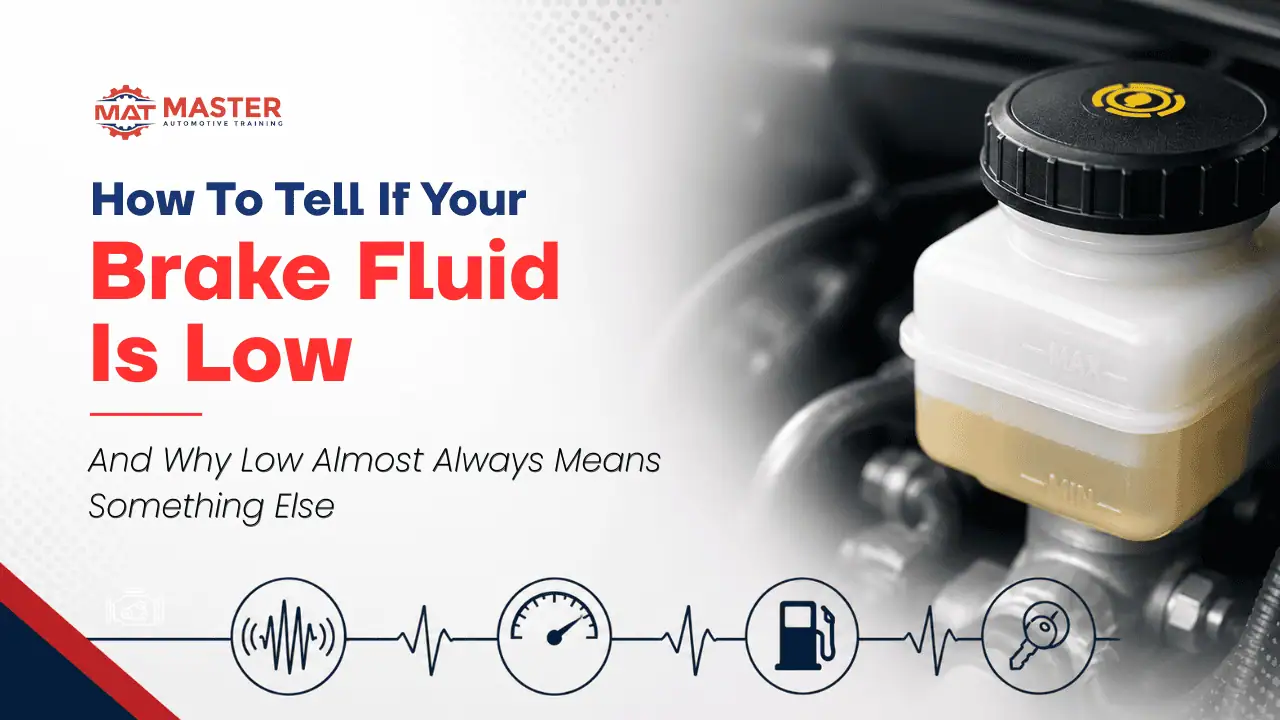
How to Tell If Your Brake Fluid Is Low — And Why Low Almost Always Means Something Else
Brake fluid doesn’t get used up. It doesn’t burn off like gas or evaporate like washer fluid. The system is sealed. So if your reservoir is low, the fluid didn’t disappear — it went somewhere.
That sentence is the whole story. Where it went tells you whether you’ve got a normal maintenance item or a reason to stop driving the car today.
Here’s how to read the difference.
1. The Warning Light You Shouldn’t Trust to Show Up
Most cars have a brake warning light tied to the reservoir float. When the fluid drops past a set point, the light comes on.
The problem? By the time that float trips, you’ve already lost a meaningful amount of fluid. And on many cars the same symbol covers the parking brake, so drivers see it, assume they left the brake on, and ignore it.
The brake light isn’t an early warning. It’s the system telling you the easy window already closed.
Don’t wait for the light. Pop the hood and look.
2. How to Actually Check It (Two Minutes, No Tools)
The reservoir is a translucent plastic tank, usually near the back of the engine bay on the driver’s side, with MIN and MAX lines on the side.
You don’t open it. You don’t dip anything in it. You just look through the wall of the tank where the fluid line sits.
Three things to read:
Level — is it between MIN and MAX, or below MIN?
Color — fresh fluid is light, almost clear gold. Old fluid is dark brown, like weak coffee. Brown means it’s overdue regardless of level.
The trend — this is the one that matters most. A reservoir that’s slightly low and slowly dropping over months tells a very different story than one that dropped fast.
Level tells you where you are. The trend tells you why.
3. The Slow Drop That Isn’t a Leak
Here’s the part most drivers never get told.
As your brake pads wear down, the caliper pistons reach further to press the pad against the rotor. That extra space fills with fluid pulled from the reservoir. So the level drops a little, naturally, as the pads thin out.
A reservoir that’s gradually crept toward MIN over a year often isn’t leaking. It’s telling you the pads are getting thin.
A slowly falling reservoir isn’t always a leak. Sometimes it’s a brake pad gauge you didn’t know you had.
Top it off and the level looks fine — until new pads go on, the pistons push back, and the fluid overflows. That’s why a good shop checks pad thickness before touching the reservoir.
4. The Fast Drop That Is a Leak
Now the dangerous version.
If the reservoir was fine last month and it’s below MIN today, fluid is escaping the system. Brakes only work because the fluid has nowhere to go but the calipers. A leak gives that pressure somewhere else to go — and that’s how a pedal goes soft.
Look for the evidence:
- A wet, oily film on the inside of a wheel or tire
- A clear-to-brown puddle under the car, near a wheel or behind the engine
- A slick spot on the master cylinder or along a brake line
Fluid that vanishes fast didn’t get absorbed. It found a way out — and so will your stopping power.
This isn’t a “watch it for a week” situation. A leaking brake system is a tow-it-in situation.
5. The Pedal Tells You Before the Reservoir Does
You don’t even need the hood up. Your foot is a sensor.
A healthy pedal is firm. It stops in the same spot every time, with a solid, planted feel.
A pedal that’s gone soft or spongy — that sinks lower than it used to, or slowly drifts toward the floor when you hold steady pressure at a light — is telling you the hydraulic system has air or it’s losing fluid. Either way, same message.
A firm pedal is a full system. A sinking pedal is a system asking for help.
If the pedal ever goes to the floor, you don’t drive it anywhere. You call for a tow.
6. The Symptom That Has Nothing to Do With Level
Here’s the one that surprises people. Your fluid can be perfectly full and still be the problem.
Brake fluid is hygroscopic — it absorbs water out of the air over time. Water lowers the fluid’s boiling point. On a hard stop or a long mountain descent, the heat at the caliper can flash that absorbed moisture to vapor. Vapor compresses. Suddenly your firm pedal goes soft right when you need it most.
Full doesn’t mean healthy. Brake fluid wears out by what it absorbs, not by how much you lose.
This is why brake fluid has a service interval — usually every two to three years — even if you never lose a drop. Dark fluid is your visual cue it’s saturated.
7. What This Means for You
Put it together and the rule is simple.
If the level is slightly low and slow — get the pads checked. It’s probably wear, not a leak, and it’s a maintenance conversation, not an emergency.
If the level dropped fast, the pedal feels soft, or you see fluid where it shouldn’t be — stop driving. That’s a hydraulic failure forming, and brakes are the one system on the car you never gamble on.
If the fluid is dark but the level is fine — you’re due for a flush, not a refill.
Topping off the fluid treats the symptom. Finding out why it dropped treats the car.