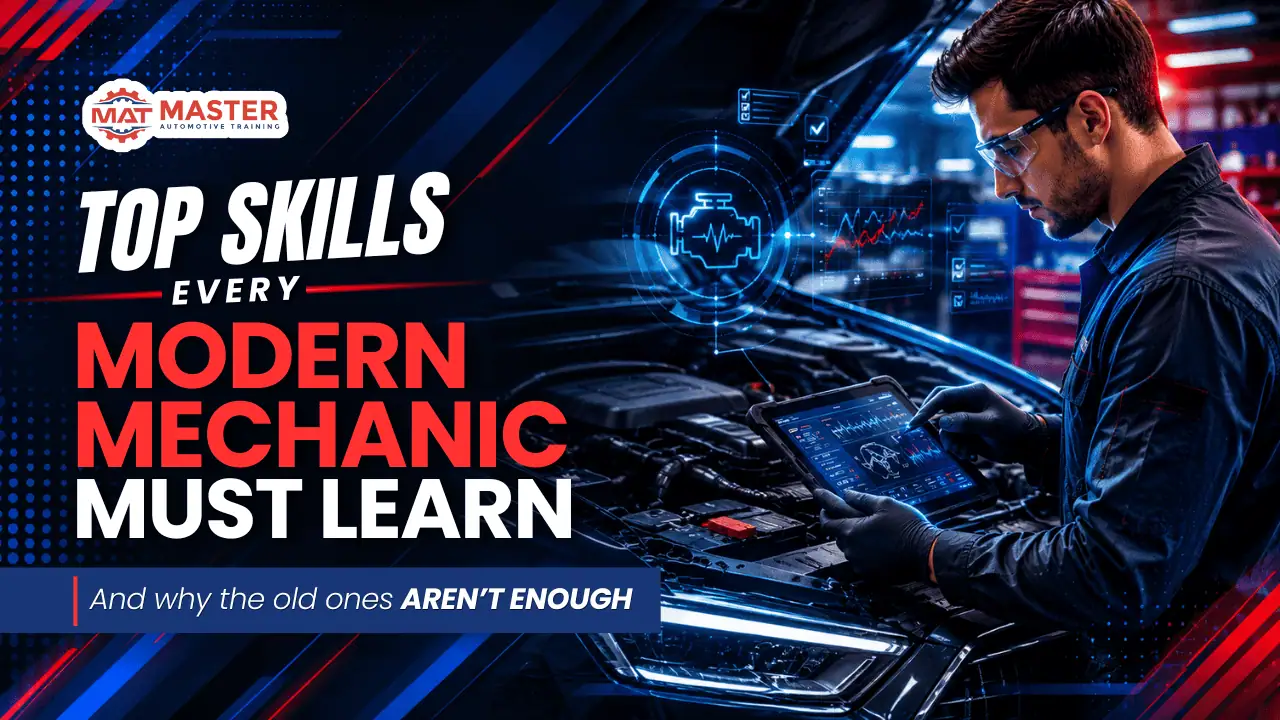
Top Skills Every Modern Mechanic Must Learn — And Why the Old Ones Aren’t Enough
The scan tool says no codes. The customer says it still drives weird. Now what?
That’s the moment that separates today’s mechanic from yesterday’s. The old skills — listening, feel, intuition — still matter. They just won’t save you anymore on their own.
Modern cars throw symptoms a hundred feet from the actual fault. The tech who solves them isn’t the one with the most wrenches. It’s the one who knows what to test, in what order, and what the patterns mean.
Here’s what that tech actually knows.
1. Network Diagnostics
Every system on a modern car talks to every other system. CAN. CAN-FD. FlexRay. When one module goes quiet, the symptoms show up everywhere except where the problem actually is.
You don’t need to memorize every protocol. You need to recognize three things on a scope.
Healthy bus: clean, repeating waveforms.
Bad module: distortion, flat spots, signals that don’t square up.
Lost terminator: ringing on the edges, the signal can’t settle.
Once you see those patterns three times, you’ll see them forever.
A scan tool tells you which module didn’t answer. A scope tells you why.
2. Scope and Waveform Analysis
A scan tool shows what a module is reporting. A scope shows what the wire is actually doing. On a modern car the gap between them is where most misdiagnoses live.
Start with the four captures that pay for themselves on day one:
- Primary ignition — catch the misfire before the cylinder gives up
- Injector current ramp — find a sticky pintle before the cat goes
- Alternator ripple — kill the “intermittent electrical gremlin” forever
- CAN-H and CAN-L — see the network issue, don’t guess
One scope, one habit of looking before reaching for parts. That’s the difference between a $200 diagnosis and a $1,200 parts cannon.
3. EV and Hybrid Safety
You don’t get to learn this one slowly. Touch the wrong wire, the wrong way, and the trade stops needing you.
Three things to lock in before you ever open an HV system.
Wire color tells you the brand. Orange means Toyota, Honda, or Tesla. Blue means Ford. Green means GM.
The fob is the killer. Get it 15 to 20 feet from the vehicle before lockout/tagout.
Current kills, not voltage. A few milliamps across your chest can trigger ventricular fibrillation. The car has hundreds of amps available. Do the math.
This isn’t the skill where you figure it out as you go. Take the course. Get the cert. Then touch the system.
4. ADAS Awareness
The car you just aligned has a camera through the windshield. The one you bumper-repaired has radar behind the cover. The brake job you finished might need a steering angle reset before it rolls out of the bay.
You don’t have to be the calibration shop. You do have to know when a calibration is required, what static versus dynamic means, and why a quarter degree of misalignment becomes a real problem at 70 mph.
The calibration didn’t matter — until the day it did. Don’t be the shop that learned the difference in a deposition.
5. Software and Reprogramming
The transmission shifts hard. The MIL won’t clear. The customer just got their car back from another shop and the same problem is already back.
Sometimes the part is fine. The calibration isn’t.
Know the basics: J2534 pass-through, OEM portal access for the brands you see most, why battery support during a flash isn’t optional, and how to read a TSB before you buy the part.
The tech who checks for updates before throwing parts saves the shop more money than any productivity hack. Quietly. Every week.
6. Communication
This is the one most techs skip. It’s also the one that decides whether your work gets paid for.
A perfect diagnosis means nothing if the advisor can’t explain it, the customer doesn’t believe it, and the job gets bumped to “let me think about it.”
Write DVI notes like a human, not a manual. Tell the why — why the part is failing, why now, what happens if it waits. The customer doesn’t need to understand the engineering. They need to understand the stakes.
Pressures tell the customer what’s broken. Words tell them why it matters.
7. The Habit of Always Learning
This is the skill that beats every other skill on the list.
New chemistries, new architectures, new failure patterns every year. The techs who win the next decade aren’t the ones who know the most today. They’re the ones who keep learning faster than the cars keep changing.
Read TSBs. Watch case studies. Take real classes. Get on a scope. Pay for training before you pay for tools.
The mechanic who stops learning becomes the mechanic who guesses. The mechanic who guesses becomes the mechanic who loses.
If You Drive a Car (And Don’t Turn the Wrench)
The shop you choose matters more than ever.
Cheap diagnostic fees almost always mean cheap diagnostics. A shop that doesn’t invest in training will throw parts until something sticks — and you’ll pay for every miss. A shop that does invest finds the issue once.
Ask your shop what tools they use. Ask if their techs go to class. Their answer tells you almost everything.
The Bottom Line
The trade isn’t getting easier. The cars are getting harder. The mechanic who wins isn’t the one with the biggest tool box. It’s the one who tests instead of guesses, learns instead of waits, and treats every diagnosis like a chance to get sharper.
Testing, not guessing. That’s the standard.
If you’re ready to build these skills, MAT runs the courses that teach them — smog inspector, VSSI, automotive diagnostics, AC/HVAC, and EV/Hybrid (L3). Real classes. Real scopes. Real cars in the bay.
Bettering the automotive industry one technician at a time.