
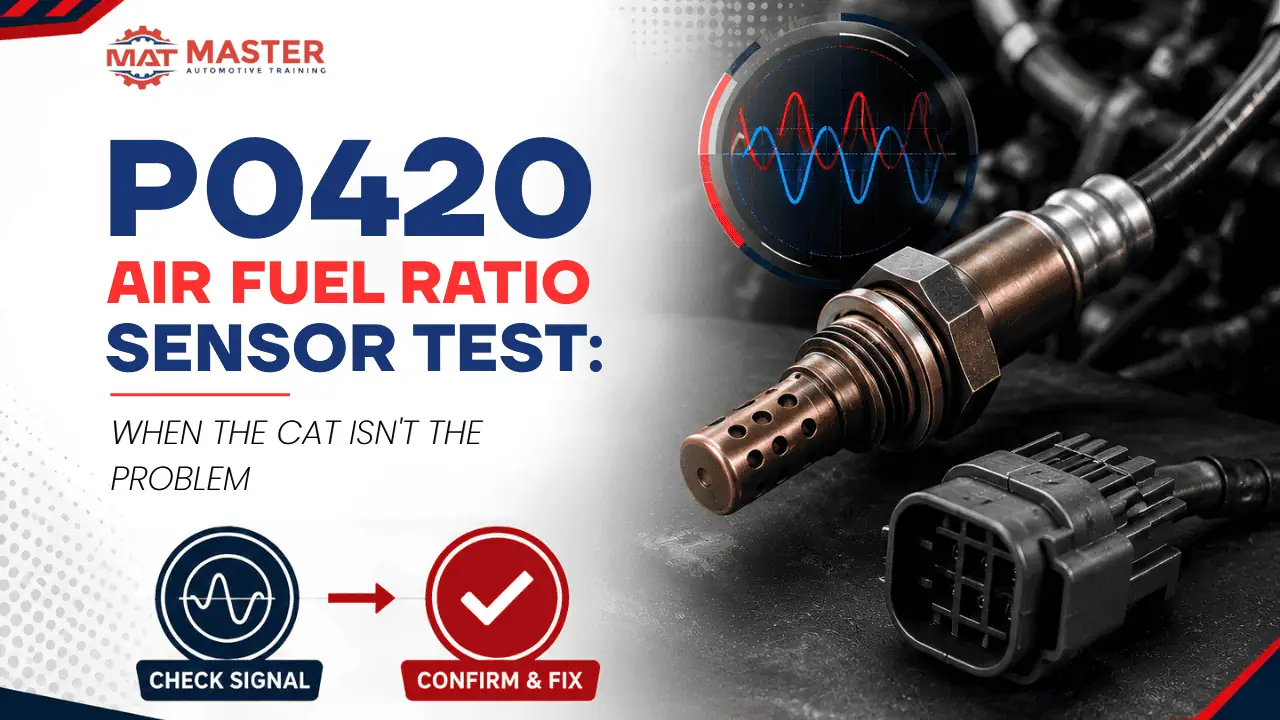
P0420 Air Fuel Ratio Sensor Test: When the Cat Isn’t the Problem
The cat didn’t need to come out. The sensor did.
The story goes like this: a P0420 lands in the bay. Pattern failure database says replace the cat. Tech pulls the converter, welds in a new one, clears the code, sends the car out. Three weeks later, the light’s back on. Same code. The tech calls the OE tech line. The first question the tech line asks is “did you test the air fuel ratio sensor?”
This happens every day. And it’s exactly why a P0420 air fuel ratio sensor test belongs in your diagnostic workflow before any catalyst gets condemned.
Pattern Failures Are a Starting Point, Not a Diagnosis
Pattern failure databases exist for a reason. When a specific vehicle, engine, and code combination tends to have one dominant root cause, the database saves techs hours of guesswork. That’s real value.
But pattern failures are statistical, not diagnostic. They tell you what’s usually wrong. They don’t confirm what’s actually wrong on the car in your bay.
When the pattern doesn’t play — when the cat goes in and the code returns — the tech line pivots to the test the pattern skipped. Nine times out of ten on a returned P0420, that test is the air fuel ratio sensor.
The pattern is a hypothesis. The test is the diagnosis.
How a Bad Air Fuel Ratio Sensor Sets Up a False P0420
Here’s the chain of failure most techs never see, because they never test for it.
The air fuel ratio sensor lives in the exhaust upstream of the catalyst. Its job is to report the exact air-to-fuel ratio arriving at the cat in real time. The PCM uses that signal to command fuel trim.
Now imagine the sensor is lazy. Its readings are biased, its response time is slow, or it’s stuck reporting one region of the range accurately and the rest incorrectly.
Watch what happens next:
- The sensor sends the PCM bad data
- The PCM commands fuel based on that bad data
- Actual air-fuel ratio arriving at the cat is now off
- The downstream O2 sensor sees abnormal switching
- The PCM compares upstream and downstream and calculates poor catalyst efficiency
- P0420 sets
The cat isn’t failing. It’s being set up to fail by a sensor feeding the system bad data.
The catalyst is the symptom. The air fuel ratio sensor is the cause.
Air Fuel Ratio Sensor vs. Traditional O2 Sensor
Before running the test, make sure you know what you’re testing.
A traditional narrowband oxygen sensor switches between two voltage states — roughly 0.1 V and 0.9 V — and tells the PCM only whether the mixture is rich or lean of stoich. The signal is a rapid, obvious sine wave.
A wideband air fuel ratio sensor is a precision instrument. It reports the actual lambda value (or air-fuel ratio) continuously, across a wide range, with a linear output. It’s not a switching signal. It’s a measurement.
That precision is exactly why a failed AF sensor is so dangerous to the diagnosis. When it fails, it usually doesn’t set its own code. It just quietly reports the wrong value — and the entire fuel control loop runs on that wrong value until something downstream sets a P0420.
A narrowband sensor tells the PCM which side of stoich it’s on. A wideband tells the PCM how far. When “how far” is wrong, everything downstream is wrong.
The Air Fuel Ratio Sensor Test
The test itself is simple. It takes five minutes and needs nothing you don’t already own.
Bring the engine to full operating temperature and closed loop. Put your scan tool in graphing mode and pull up the air fuel ratio sensor signal — usually shown as lambda, equivalence ratio, or A/F ratio depending on the tool.
Watch the baseline. On a healthy sensor at warm idle, the value sits close to 1.00 lambda with small, quick corrections around it.
Now introduce a controlled disturbance. Pull a vacuum line to create a lean condition. Watch the sensor.
- A healthy sensor tracks the input. The lambda value climbs immediately and cleanly. The trace responds proportionally to the size of the leak. Reconnect the line and the value returns to baseline just as quickly.
- A failed sensor barely moves. The trace lags, mutes, or barely reacts to a disturbance that should have swung it significantly. Sometimes it moves the right direction but not far enough. Sometimes it flatlines.
For a rich-side check, meter a small amount of propane into the intake and watch for the mirror response.
A sensor that can’t follow a controlled input can’t follow the engine either.
What to Do When the Sensor Fails the Test
Replace the air fuel ratio sensor with an OE or OE-equivalent unit. Cheap aftermarket wideband sensors are notorious for reporting the wrong values right out of the box. This is not the part to save money on.
After replacement:
- Clear stored codes and freeze frame data
- Complete a full drive cycle to run the catalyst monitor
- Verify P0420 does not return
- Document the actual sensor response test in your DVI or work order
Now you know what fixed it. So does the customer. So does the next tech who reads the file.
Why This Test Matters More Than It Ever Did
A catalyst replacement on a modern vehicle runs anywhere from a few hundred dollars into four figures. An air fuel ratio sensor is a fraction of that.
More important, a wrong-diagnosis converter replacement doesn’t just cost money. It costs trust. The customer paid for a repair that didn’t fix the problem. Your comeback rate climbs. Your reputation takes the hit.
Five minutes with a scan tool, a vacuum line, and a warm engine keeps all of that off your books.
The Bottom Line
Pattern failures follow the odds. Testing follows the evidence.
Dealers follow pattern failures — and then they call tech line when the pattern didn’t work. The test was always available. It just wasn’t part of the pattern.
Add the P0420 air fuel ratio sensor test to your standard workflow, and the pattern stops writing the diagnosis for you.
Master Automotive Training teaches the diagnostic habits that beat pattern-failure guessing — real testing, real scopes, real cars in the bay. Automotive diagnostics, EV/Hybrid (L3), and more.
Bettering the automotive industry one technician at a time.