
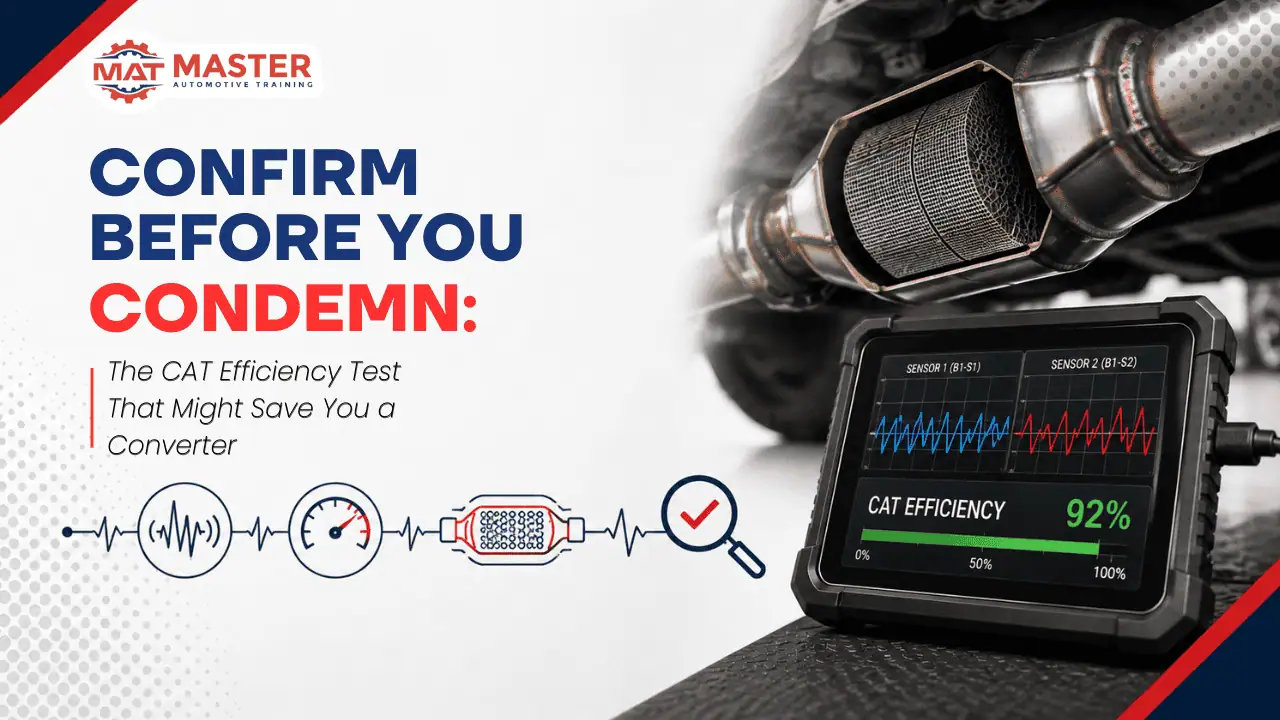
Confirm Before You Condemn: The Cat Efficiency Test That Might Save You a Converter
You got a P0420. Cat efficiency below threshold. The tech pulls the converter, welds in a new one, clears the code, sends the car out.
Three weeks later, the light’s back on. Same code.
The converter wasn’t the problem. Or it was — but only at idle. Or it was, but for a reason no new cat is going to fix.
This is where most P0420 diagnoses go wrong. The code isn’t wrong. The interpretation is.
A trouble code is a result, not a diagnosis. P0420 tells you what the PCM concluded from two sensor readings. It doesn’t tell you what the cat is actually doing — or why. Here’s how to figure that out before you order the part.
1. What the Code Is Actually Measuring
P0420 is set when the PCM compares the upstream and downstream heated O2 sensors and decides the converter is no longer doing its job.
Both are zirconia switching-type sensors. Both generate their own voltage between 0 and 1 volt based on oxygen content in the exhaust. The PCM watches how the two signals relate over time, and if the downstream starts behaving too much like the upstream, it sets the code.
The code is the conclusion of that comparison. Your job is to read the two signals yourself and either confirm the PCM’s conclusion or find the exception the PCM missed.
The PCM only sees averages. You get to see the trace.
2. What Healthy Looks Like
Graph both O2 sensors together. Warm engine, in closed loop, at idle.
The upstream sensor should be switching rapidly — 0.1 volt to 0.9 volt, back and forth, every fraction of a second. That’s normal closed-loop fuel control at work. The PCM is trimming rich, seeing the correction, trimming lean, seeing that correction, and repeating.
The downstream sensor should look almost nothing like that. Behind a healthy converter, the trace is flat, stable, barely moving — usually somewhere in the mid-voltage range, quiet.
Why? Because a working cat has oxygen storage capacity. It grabs excess oxygen during lean cycles, releases it during rich ones, and smooths out everything the upstream sensor was reacting to. The downstream sees the result of the cat’s work, not the raw exhaust.
Upstream reads the engine. Downstream reads the cat.
3. The Confirmed Failure Pattern
Now the failure fingerprint.
If the downstream trace starts switching at roughly the same rate and amplitude as the upstream — matching every rich-to-lean swing — the cat has lost oxygen storage capacity. There’s no buffer left. Whatever hits the upstream sensor is passing straight through to the downstream sensor untouched.
That’s efficiency failure, confirmed by the trace, not just the code.
But before you order the converter, run one more test.
4. The RPM Test That Saves Cats
Keep the graph running. Raise the RPM to 2500 and hold it steady. Watch what the downstream trace does.
Then raise it to 3500 and watch again.
Here’s what you’re looking for: does the downstream stabilize and flatten out at higher RPM?
If it does, that cat may not be dead. It may just not be getting what it needs at idle to work properly. Higher exhaust temperature and a different air-fuel ratio under load can bring a catalyst back to full function — meaning the “failure” you saw at idle wasn’t the converter, it was the conditions.
A cat that works at 3500 RPM but switches at idle is a completely different conversation than a cat that fails at every RPM.
If the downstream still tracks the upstream at 2500 and 3500, the converter is genuinely spent. Replace it.
If it flattens as RPM climbs? You’ve just saved a $600 to $2,000 part and pointed the diagnosis somewhere else entirely.
5. Why the RPM Test Works (The Short Version)
Catalytic converters aren’t always-on devices. They’re chemical reactors, and reactors need the right conditions to run: sufficient temperature, and the right air-fuel ratio arriving at the substrate.
At idle, the exhaust is cooler and the mixture is closer to stoich. That should be enough for a healthy cat — but if anything upstream is preventing the cat from reaching or holding light-off temperature, it won’t function properly at low load. Raise the RPM, raise the exhaust temperature, and the cat wakes up.
When that happens, the real fault isn’t inside the converter at all. It’s upstream:
- A coolant temp reading that keeps the engine in extended open-loop
- A thermostat that won’t close
- A worn plug or coil delivering weak combustion and cool exhaust
- An exhaust leak ahead of the cat pulling temperature away
Replacing the cat when any of those is the root cause is how the same code comes back three weeks later. (The full “why cats need temperature and AFR to light off” story is its own diagnostic — one worth its own post.)
6. Build the Habit
Any time a P0420 hits your bay, run the same three-step confirm:
- Graph upstream and downstream at warm idle. Baseline the signals against what healthy looks like.
- Check for downstream mirroring upstream at idle. That’s your failure pattern.
- Raise RPM to 2500 and 3500 and re-check downstream behavior. If it flattens as RPM climbs, the cat may be salvageable — the fault is somewhere else.
Five minutes with a scan tool in graph mode. That’s the whole test.
The Bottom Line
The code told you cat efficiency below threshold. The test tells you why. Those are not the same answer, and the difference is often a $1,000 part.
Confirm before you condemn.
Read both sensors. Watch the pattern. Sweep the RPM. Let the cat tell you whether it’s dead, dying, or just cold — before you cut it out.
Master Automotive Training teaches the confirm-before-you-condemn diagnostic habits that separate parts-swappers from real diagnosticians — automotive diagnostics, graph mode and scope work, EV/Hybrid (L3), and more.
Bettering the automotive industry one technician at a time.