
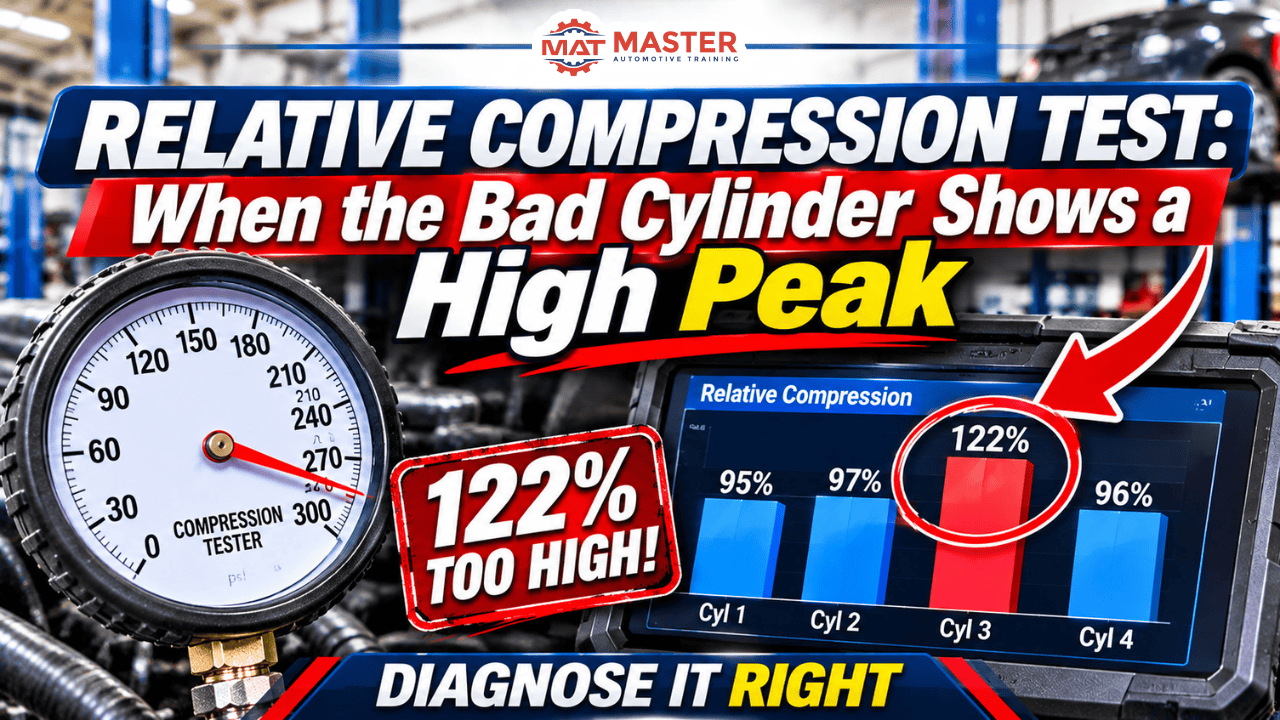
Relative Compression Test: When the Bad Cylinder Shows High
Relative compression test on the scope. Three cylinders look completely similar. Cylinder one has a peak that’s noticeably higher than the rest.
Most techs — including good ones — look at cylinder one.
The problem was cylinder four. Its exhaust valve wasn’t opening.
Two things fooled the diagnosis at once. The bad cylinder showed high instead of low. And the peak appeared on the waveform at a completely different cylinder than the one that was actually failing. Miss either of those quirks and you spend the next hour chasing the wrong hole.
Here’s how a relative compression test actually reads, and why the pattern you expect to see is only half the story.
1. How a Normal Relative Compression Test Works
The premise of an RC test is elegant. You crank the engine with the injectors and coils disabled, and clamp a current probe on the starter cable while the engine turns. Each cylinder that reaches its compression stroke fights the starter for a moment. That fight shows up as a current spike on the scope — one hump per compression event.
If every cylinder is sealing the same, all the humps are the same size. Consistent waveform, consistent compression.
If a cylinder is losing compression — worn rings, a burnt valve, a blown head gasket — it puts up less resistance to the starter turning it. Less resistance means less current draw at that event. A weak hump means a weak cylinder.
Low hump. Bad cylinder. That’s the pattern every tech is taught.
The pattern is real. It just isn’t the only one.
2. When the Pattern Inverts — A Stuck Exhaust Valve
Now the mirror-image failure: a cylinder whose exhaust valve isn’t opening at all — a broken rocker, a wiped cam lobe, a dropped lifter, a seized valve. The intake side still works. The compression side still works. But the exhaust stroke can’t dump the burned gases out of the cylinder.
Here’s what happens next.
On the exhaust stroke, the piston rises to push the burned gases out. The exhaust valve stays closed. The gases have nowhere to go.
On the following intake stroke, the intake valve opens onto a cylinder that’s still full of pressurized exhaust. Fresh air-fuel mix gets pulled in on top of the trapped gas.
Now the compression stroke arrives. The starter is being asked to compress both the fresh charge and the exhaust gases the cylinder never got to expel. Per Paul Danner’s writing on the technique — echoed in Gears Magazine — this creates effectively a double compression event.
The waveform shows a peak significantly higher than every other cylinder. Not lower. Higher.
A weak cylinder draws less current. A cylinder with a stuck exhaust valve draws more.
Same test. Opposite signal. Completely different diagnosis.
3. The Firing Order Trap — Why the Peak Shows Up at the Wrong Cylinder
Here’s where the second layer of the trap catches even techs who know about the high-peak pattern.
The starter motor doesn’t respond instantly to changes in load. When cylinder four creates that huge compression resistance, the starter labors under it — physically slows down. Once it clears that hump, it accelerates again to catch back up.
That speed change matters. It shifts the current reading at the next cylinder event in the firing order.
The waveform is time-based, and the firing order determines the order in which humps appear on the trace. When cylinder four’s resistance drops off and the starter suddenly speeds up, the next cylinder in the firing order shows a distorted current signature — often a peak that looks like it belongs to that cylinder.
So the peak on the screen is at cylinder one. The fault is at cylinder four. On a 1-3-4-2 firing order, cylinder four is the one that fires immediately before cylinder one. That’s not a coincidence. That’s the crank dynamic showing up one event late.
Chase the peak and you chase the wrong cylinder.
4. Reading the Waveform Correctly
The move that catches this is small: always cross-reference the waveform against the firing order for the engine you’re testing.
When a high peak appears out of pattern, don’t jump on the cylinder it’s sitting under. Ask: what’s the cylinder that fires immediately before it in the firing order? That’s the one to inspect. The high peak is the after-effect of a resistance event that happened one cylinder ago.
Then verify. Cross-check with a running compression test on the suspected cylinder. Cross-check with a mechanical compression test — the cylinder with the stuck exhaust valve usually shows a wildly elevated static compression reading too, because the trapped gases never left. Cross-check with a scope on the ignition or a leak-down if available.
The RC test points you in a direction. Verification confirms which direction.
5. Two Failure Patterns, One Test
Once you understand both signals, a relative compression test becomes twice as useful as most techs realize.
Low hump = compression loss. Worn rings, burnt intake or exhaust valve seat, blown head gasket, cracked piston. Traditional cylinder leakage. Verify with a leak-down test.
High hump = exhaust valve not opening. Broken rocker arm, dropped hydraulic lifter, wiped cam lobe, seized exhaust valve, valve spring failure. Verify by watching the valve mechanically or measuring valve lift.
Same tool. Same 60-second test. Two completely different failure modes revealed depending on which direction the anomaly points.
6. The Habit — Don’t Trust the Obvious Peak
Every diagnostic tool has a signal pattern the operator expects to see, and every diagnostic tool has an exception pattern that looks like something else entirely. The RC test is one of the cleanest examples in the trade.
The peak that jumps off the screen is not always the fault. It might be a resistance event echoing one cylinder late. It might be the opposite of what you were trained to look for. It might be both at once.
The move is the same one that runs through every real diagnosis: don’t trust the obvious. Verify what the tool is actually telling you.
The Bottom Line
Relative compression testing is a fast, powerful tool. It also has a specific failure mode that fools techs who only know the expected pattern.
The bad cylinder was not low. It was high. And it was not where you thought it should be.
Learn both halves of the signal. Cross-reference the firing order. Verify with a second test. That’s the discipline that turns a good tech into one nobody in the shop wants to second-guess.
Master Automotive Training teaches the waveform interpretation and cross-verification habits that separate real diagnosis from pattern-matching — automotive diagnostics, scope work, A6 Electrical/Electronic Systems, and EV/Hybrid (L3). Real cars, real bays, real learning.
Bettering the automotive industry one technician at a time